



The Problem with a 'Smoking Gun'
In movies, finding alien life is simple: a rover spots a fossil or a telescope detects a single, unambiguous signal. In reality, astrobiology is far more complex and cautious. Many chemical compounds that are essential for life on Earth, like amino acids
or certain gases, can also be created by non-biological processes. Finding one of these so-called biosignatures is an exciting start, but it's not definitive proof. Relying on a single data point is risky because it could be a false positive—an observation that seems to indicate life but has a non-living explanation. The history of science is filled with premature claims that were later debunked, such as the debate over microscopic fossils in the Martian meteorite Allan Hills 84001. This is why astrobiologists today operate more like detectives building a comprehensive case than treasure hunters looking for one piece of gold.
Building the Case: A Multi-Tool Approach
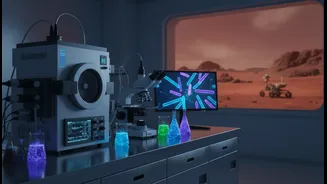
Instead of relying on one test, scientists advocate for using multiple, independent lines of investigation. This means deploying a suite of chemical detection tools, each looking for different types of clues. For example, one instrument might analyze the complexity and structure of organic molecules, while another measures the ratios of different isotopes in a sample. Life tends to prefer certain isotopes, leaving behind a distinct chemical fingerprint that is different from random geological processes. Another technique, called capillary electrophoresis, can separate and identify a wide range of amino acids—the building blocks of proteins—with thousands of times more sensitivity than methods currently used on Mars rovers. By combining these and other methods, scientists can cross-check their findings. If different, independent tests all point towards a biological origin, the confidence in the discovery grows exponentially.
Why the Environment Is Everything
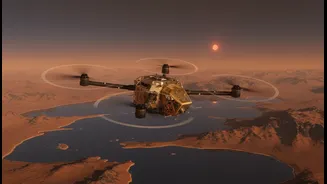
A chemical signature means nothing without understanding its surroundings. This is where environmental context becomes critical. The same methane signal detected on Mars, a dry and irradiated planet, would be interpreted differently from methane found on Titan, a moon with a thick atmosphere and liquid hydrocarbon lakes. Scientists must consider the planet's geology, atmosphere, temperature, and radiation levels. These factors help determine whether a non-biological explanation is plausible. For instance, some geological processes can produce gases that mimic biosignatures. By thoroughly studying the environment, researchers can rule out these abiotic sources. This holistic view ensures that a potential sign of life is consistent with its location, strengthening the biological hypothesis. Understanding the co-evolution of life and the environment on Earth provides a crucial roadmap for this work.
Converging Evidence: The Gold Standard
The ultimate goal is to achieve what scientists call "converging evidence." This is the principle that multiple, independent measurements must all point to the same conclusion. It’s not enough for one instrument to find something interesting. True confidence comes when a mass spectrometer, a laser analyzer, and a microscopic imager all produce data that, taken together, can only be explained by life. To help standardize this process, NASA scientists have even proposed a "Confidence of Life Detection" (CoLD) scale. This seven-level framework helps scientists communicate the strength of their evidence, moving from an initial hint of a signal (Level 1) to confirmation from a sample returned to Earth (Level 7). This structured approach helps manage expectations and ensures that any claim of discovering extraterrestrial life has been rigorously vetted against all other possibilities.