
Reading the Rainbow of Distant Worlds
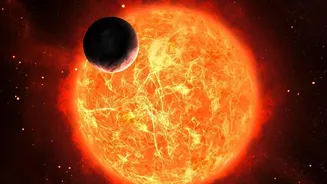
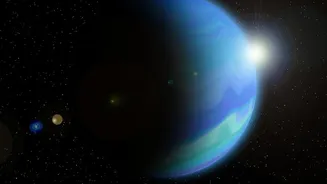
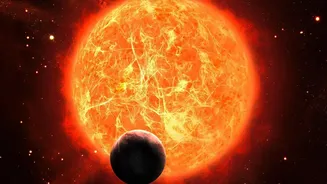
So, how exactly does a telescope see water hundreds of light-years away? The technique is both brilliant and surprisingly simple in concept. It's called transmission spectroscopy. When an exoplanet passes in front of its host star from our perspective,
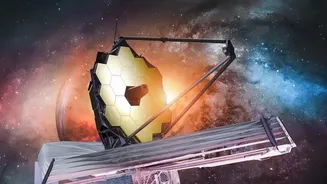
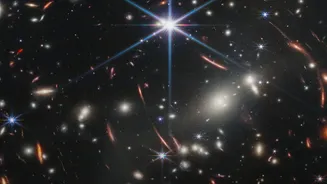
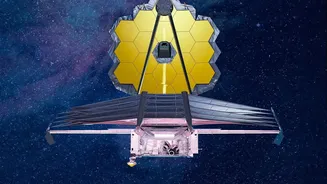
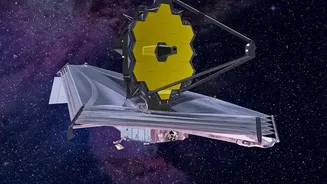
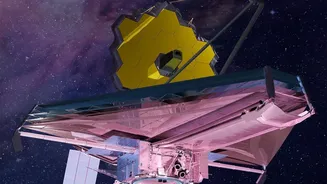
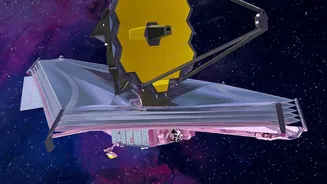
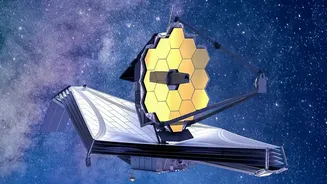
a tiny fraction of the starlight filters through the planet's atmosphere. The molecules in that atmosphere absorb specific colours, or wavelengths, of light. Every gas leaves a unique chemical fingerprint on the light that reaches the telescope. Water, as it turns out, has a very distinct and recognisable signature. JWST's powerful deep-field instruments, like the Near-Infrared Spectrograph (NIRSpec) and Mid-Infrared Instrument (MIRI), are exquisitely sensitive to these subtle changes in starlight. They essentially analyse a rainbow of infrared light, find the specific colours that are missing, and tell astronomers exactly which gases, like water vapour, are present in that alien air.
A Growing Gallery of Watery Skies
The list of exoplanets with confirmed water in their atmospheres is growing, showcasing the incredible power of the JWST. One of the first and most famous examples was WASP-96 b, a hot, puffy gas giant about 1,150 light-years away. The telescope provided an unambiguous detection of water, along with evidence of haze and clouds that were previously thought not to exist there. But it hasn't stopped with gas giants. Astronomers have pointed Webb at more exotic targets, like GJ 9827 d, a potential 'steam world' whose atmosphere may be predominantly made of hot water vapour. On another world, the 'fluffy' exoplanet WASP-107b, it found not only water but also clouds made of sand. Each discovery serves as a crucial proof of concept, demonstrating that our technology is capable of peering into the atmospheres of worlds fundamentally different from our own.
Water Before Worlds Even Form
Perhaps the most profound discovery so far came not from a fully formed planet, but from a stellar nursery. In the PDS 70 system, located 370 light-years away, JWST detected abundant water vapour in the inner, planet-forming disk of gas and dust. This is the region where rocky, terrestrial planets like Earth are thought to assemble. Finding water here is a monumental discovery. It means that the raw material for life-giving oceans isn’t just something that might arrive late to the party via comets or asteroids; it can be present from the very beginning, baked into the planets as they form. This discovery radically boosts the odds that rocky exoplanets forming in other systems will have access to water, a key ingredient for habitability as we understand it.
Not Life, But the Next Best Thing
It is crucial to be clear: detecting water vapour does not mean we have found life. Most of these initial detections have been on planets that are far from hospitable, like scorching-hot gas giants orbiting perilously close to their stars. The planet WASP-18 b, for instance, is so hot that its temperature reaches nearly 2,700 degrees Celsius, yet Webb's instruments were still sensitive enough to pick up the faint signature of the water molecules that survived the heat. What these findings represent is a technological turning point. They prove that JWST can successfully identify the building blocks of life from across the galaxy. The next chapter, which is already beginning, involves turning this powerful tool towards smaller, cooler, rocky planets that orbit within their star’s 'habitable zone'—the just-right distance where liquid water could potentially exist on a planet's surface. Worlds like K2-18 b, a potential 'ocean world', are prime targets for this next phase of investigation.