



The Devastating Aftermath
Recent research, not yet peer-reviewed, paints a grim picture: a hypothetical 1-megaton nuclear blast 500 kilometres up could disable approximately 98% of all satellites in low Earth orbit (LEO) within a single week. The study, conducted by physicists
at the University of Wisconsin-Madison and Princeton University, highlights a vulnerability that goes far beyond the initial explosion. While the first wave of X-rays would disable some satellites instantly, the far greater danger comes from what happens next. The detonation would create an artificial radiation belt, trapping high-energy electrons from the fission products within Earth's magnetic field. Satellites, whipping around the planet, would repeatedly fly through this toxic zone, their sensitive electronics absorbing a cumulative, fatal dose of radiation.
A Fragile Lifeline in the Sky
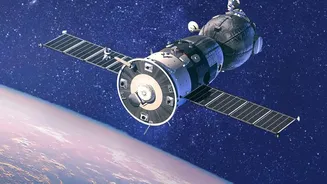
Today, more than 13,000 active satellites operate in LEO, forming the backbone of our modern world. They are essential for services we use every day, from GPS navigation that guides our cars and planes to the financial transactions that power the global economy. They also provide critical weather forecasting, global communications, and vital military and intelligence functions. The simulation suggests that even if satellites were built to be three times more resistant to radiation, 97% would still be disabled within two weeks. This is not about a single point of failure, but the systemic collapse of an entire layer of infrastructure that society now takes for granted.
A Cascade of Collisions
The danger doesn't end with fried electronics. Once a satellite is disabled, it loses its ability to manoeuvre. It becomes a piece of high-speed junk, tumbling uncontrollably through an already crowded space. The simulation predicts that a mass disabling of this scale would lead to a sharp increase in collisions. Researchers expect approximately 20 collisions within just two years following the blast. Each collision would create a new cloud of debris, which in turn could strike and destroy other objects, potentially triggering a chain reaction known as the Kessler syndrome. This would render entire orbital bands unusable for years, making it incredibly risky to launch replacement satellites. New satellites would be flying into an environment still hot with radiation and newly cluttered with fast-moving shrapnel.
A Lesson from History
This chilling scenario is not purely theoretical. In 1962, during the Cold War, the United States conducted the 'Starfish Prime' test, detonating a 1.4-megaton nuclear warhead about 400 kilometres over the Pacific Ocean. The electromagnetic pulse (EMP) and resulting radiation belts were far more powerful than expected. The blast damaged or destroyed at least a third of the satellites in orbit at the time—of which there were only a few dozen. The lingering radiation from Starfish Prime affected space for years. Today, with thousands of times more satellites in orbit, a similar event would be exponentially more devastating.