


A World of Possibility
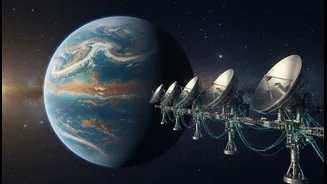
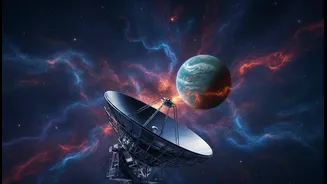
K2-18b has captured the imagination of astronomers and the public alike. It’s a 'sub-Neptune'—larger than Earth but smaller than Neptune—orbiting within its star's habitable zone, the region where liquid water could exist. Recent observations from the James
Webb Space Telescope (JWST) have suggested it could be a 'Hycean' world: a planet with a hydrogen-rich atmosphere and a globe-spanning ocean. What truly propelled K2-18b into the spotlight were findings of carbon-bearing molecules like methane and carbon dioxide, key ingredients for life as we know it. Even more intriguing was the tentative hint of dimethyl sulfide (DMS), a substance that, on Earth, is overwhelmingly produced by living organisms, particularly marine phytoplankton.
Listening to Light, Not Radio
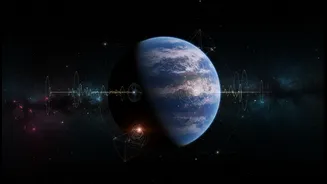
While the headline mentions radio signals, the primary method for studying K2-18b's atmosphere is actually a technique called transit spectroscopy. It doesn't involve listening for radio transmissions in the traditional sense, like in SETI searches. Instead, scientists watch the exoplanet as it passes in front of its host star. As the star's light filters through the planet's atmosphere, gases absorb specific wavelengths, or colors, of that light. This creates a unique chemical 'fingerprint' or barcode in the light that reaches the JWST. By analyzing which slivers of light are missing, astronomers can deduce which molecules are present millions of kilometres away.
The Cosmic Static Problem
Decoding this fingerprint is incredibly difficult because the signal is minuscule and plagued by 'noise' or errors. A major source of this static is the host star itself. Stars aren't uniform balls of light; they have darker, cooler starspots and brighter, hotter regions which can change over time. These stellar features can create patterns in the light that mimic or mask the signature of a molecule in the planet's atmosphere. Furthermore, the telescope's own instruments have limitations and introduce their own noise. Raw data from space telescopes is often messy, and the field of exoplanetary atmosphere characterization is still new and working through these 'teething problems'.
The Digital Sieve
To filter true signals from this cosmic noise, scientists employ a multi-step process of digital sifting. It begins with automated data pipelines that clean up the raw data by removing known sources of instrumental interference. The real heavy lifting, however, is done with complex computer models. Scientists create thousands of simulated versions of the K2-18b system, testing countless combinations of atmospheric gases, cloud formations, and stellar activity. They then compare the 'fingerprint' generated by each model to the actual data received by the JWST. The models that provide the best fit to the observations are considered the most likely explanation for what is happening on the planet. This process, known as atmospheric retrieval, is a cornerstone of modern exoplanet science.
Cross-Checking the Evidence
Science demands reproducibility, and a single analysis is never the final word. The scientific community's gold standard is for independent teams to re-analyze the same data using different methods and models. This process is crucial for catching errors and building confidence in a discovery. In the case of K2-18b's potential DMS signal, this is exactly what's happening. Different groups of scientists have re-examined the JWST data, leading to a vigorous debate. Some analyses support the initial findings, while others suggest the signal could be an artifact of the data processing or that other molecules could explain the data just as well. This back-and-forth isn't a sign of failure; it's the scientific method in action, rigorously testing an extraordinary claim.