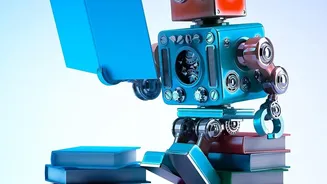








What is AI Literacy, Really?
For years, Artificial Intelligence was the exclusive domain of developers, data scientists, and engineers. But that's changing fast. Today, 'AI literacy' doesn't mean you need to know how to code a neural network. Instead, it’s about understanding what
AI can do, how to use AI-powered tools effectively, and recognising its limitations. It's the ability to ask the right questions of an AI, interpret its answers critically, and apply those insights to your specific role, whether you're in marketing, finance, or human resources. Think of it less as learning to build the engine and more as learning how to drive the car—safely and efficiently—to get to your destination. This new focus on practical application is turning AI into a general-purpose technology, much like the internet or the spreadsheet before it.
The Rush to Upskill: A C-Suite Priority
Indian companies are rapidly moving from experimentation to full-scale AI adoption. This isn't just about chasing the latest trend; it's a strategic move driven by tangible benefits. A recent EY survey highlighted that an overwhelming majority of Indian employers (90%) and employees (86%) agree that AI boosts productivity and enhances the quality of work. India leads globally in AI adoption at work, with some studies indicating that as many as 62% of employees use Generative AI regularly. This widespread integration has made upskilling a critical priority. Companies recognise that to get a real return on their investment in AI tools, their people must know how to use them. Training providers are seeing a significant shift, with a large percentage of professionals enrolling in AI programs now coming from non-technical backgrounds, including senior leaders with over a decade of experience.
Beyond the IT Department
The demand for AI skills is now present across all business functions. Marketing teams are using AI to analyse customer data and create personalised campaigns. HR professionals are leveraging AI tools to streamline recruitment and improve employee engagement. In finance, AI is helping with more accurate forecasting and risk analysis. According to one report, nearly 25% of individuals learning AI now come from non-technical fields. This democratisation is enabled by the rise of no-code AI platforms and training modules that focus on practical application rather than complex programming. The goal is to create an AI-ready workforce where every employee, regardless of their role, can contribute to innovation and efficiency.
What Skills Are in Demand?
As AI becomes a core business tool, the specific skills in demand are also evolving. Foundational knowledge of different AI types, like machine learning and generative AI, is a starting point. However, the real value lies in applied skills. Prompt engineering—the art of crafting clear and effective instructions for AI models—has become crucial. So has data literacy, which is the ability to understand and question data-driven insights. Crucially, as AI takes over routine tasks, uniquely human skills are becoming more valuable. These include critical thinking, problem-solving, and ethical judgment—knowing when to trust an AI's output and when to question it. This focus is shifting training from long-format technical courses to shorter, role-specific programs that equip professionals with skills they can deploy immediately.
The Future of Work in India
The integration of AI is reshaping the Indian job market. While it automates certain repetitive tasks, it's also creating new roles and augmenting existing ones. Studies suggest that for now, AI is creating more jobs in India than it is eliminating, although it is disrupting entry-level hiring. The key to navigating this transition is continuous learning. Government initiatives like the 'IndiaAI FutureSkills' program aim to build broad, employable AI capability across the nation. For professionals, the message is clear: AI is no longer an optional skill for a select few. Just as digital literacy became a prerequisite for office work two decades ago, AI literacy is becoming the new standard for career relevance and growth in India's dynamic economy.