

The Sun's Violent Potential
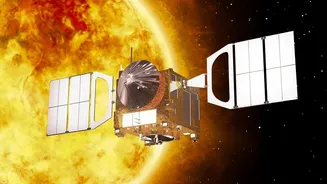
An extreme space event, often compared to the historic Carrington Event of 1859, involves the Sun ejecting a massive cloud of magnetised plasma, known as a coronal mass ejection (CME). If aimed at Earth, this stream of energetic particles can severely
disrupt our planet's magnetic field, triggering a powerful geomagnetic storm. While smaller storms are relatively common, a Carrington-level event is a once-in-a-century or two occurrence that could have catastrophic effects on modern technology. The 1859 storm was powerful enough to cause telegraph systems to fail and auroras to be seen as far south as the Caribbean; a similar event today would strike a world infinitely more reliant on delicate electronics.
Our Vulnerable Digital Canopy
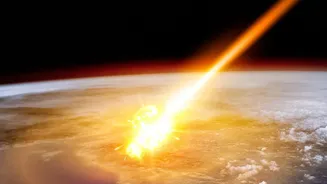
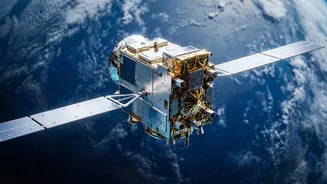
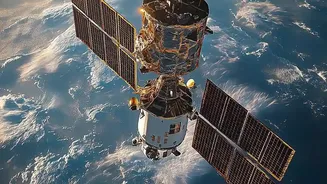
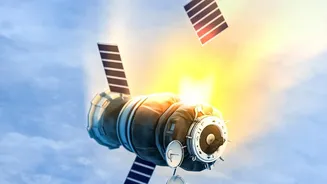
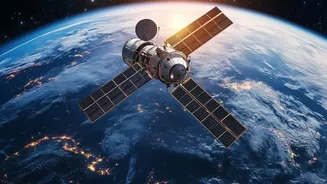
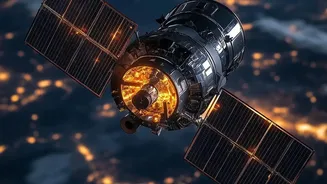
Satellites are uniquely vulnerable to these solar outbursts. The risks are multifaceted. Firstly, increased radiation can fry sensitive electronics and degrade solar panels, shortening a satellite's operational lifespan by years or causing outright failure. Secondly, the storm heats and expands Earth's upper atmosphere. This increases the atmospheric drag on satellites in Low Earth Orbit (LEO), causing their orbits to decay faster. If their onboard propulsion cannot counteract this drag, they risk re-entering the atmosphere and burning up, a fate that befell dozens of Starlink satellites after a moderate storm in 2022. Finally, the charged particles can cause 'single-event upsets'—bit flips in the electronics that lead to malfunctions—and disrupt the very communication and navigation signals we rely on them for.
Modeling a Cascade of Failures
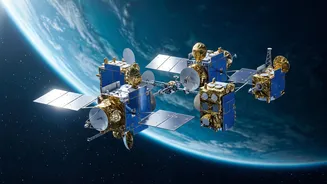
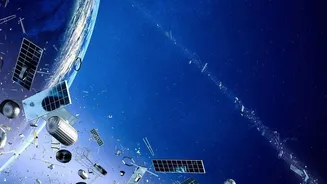
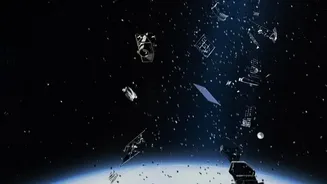
Recent research and simulations, such as those conducted by the European Space Agency (ESA), model what would happen in a worst-case scenario. These hypothetical models predict that an extreme storm could overwhelm even well-protected satellites. In such an event, no spacecraft would be truly safe. The models analyse the cascading effects. A single satellite failure is manageable, but an extreme storm could cause widespread malfunctions simultaneously. This could disrupt entire constellations, and the loss of command and control could prevent operators from performing crucial collision-avoidance manoeuvres. Studies suggest that this could increase the risk of a Kessler Syndrome scenario, where collisions create a cascade of debris that makes entire orbits unusable.
The Real-World Consequences
The downstream effects of mass satellite failure would be immense. Global navigation systems (GNSS) like GPS would become unreliable, impacting aviation, shipping, and ground transport. The May 2024 solar storm, which was significantly weaker than a Carrington-level event, caused an estimated $500 million loss to US agriculture alone due to GPS disruptions. Financial systems that rely on precise satellite timing for transactions would face chaos. Communications would be severely hampered, from mobile networks to global internet services. Weather forecasting and disaster response, which depend heavily on satellite imagery and data, would also be compromised, leaving populations more vulnerable.
Building Resilience in Orbit
While the scenario is alarming, the research is not about predicting doom but promoting preparedness. Mitigation strategies are a key focus. These include 'hardening' satellites with better radiation shielding and more resilient electronic components. Some research suggests an additional 1.5 to 2 mm of aluminum shielding could be sufficient for many satellites to survive an extreme event. Improved space weather forecasting is also critical, as it gives operators time to put satellites into a 'safe mode', orienting them to minimise damage and raising their orbits to counteract atmospheric drag. For large constellations, redundancy is also a strategy; designing the network so that the loss of several satellites doesn't bring down the entire system.