






The Overachiever in Orbit
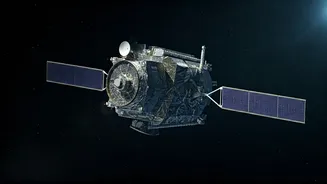
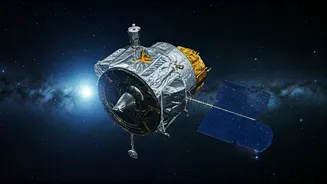
Launched in November 2004, the Neil Gehrels Swift Observatory was a game-changer. Its mission was to be astronomy's first responder, designed to rapidly detect gamma-ray bursts (GRBs)—the most powerful explosions in the universe—and instantly pivot to study
them with its suite of telescopes. Its name wasn't an acronym but a description of its key feature: the ability to reorient itself in under a minute to catch these fleeting, cataclysmic events. The original mission was planned for a modest two years. Instead, Swift delivered over two decades of groundbreaking science, observing everything from comets in our solar system to the birth of black holes in distant galaxies. Its longevity provided an incredible return on its initial $250 million investment, making it one of NASA's most productive and cost-effective missions.
An Unexpected End and a New Beginning
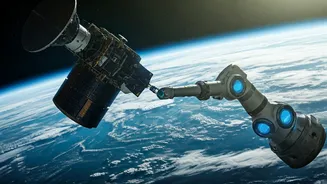
After more than 20 years, Swift wasn't brought down by a failure of its core instruments, but by something much more mundane: gravity. Increased solar activity in recent years has caused Earth's upper atmosphere to expand, creating extra drag on satellites in low-Earth orbit. Without its own propulsion system to counteract this pull, Swift's orbit began to decay, threatening to send the celebrated observatory burning up in the atmosphere by the end of the year. But instead of letting the mission end, NASA opted for a novel solution: a rescue. The agency hired a commercial partner, Katalyst Space, for a high-risk, high-reward mission to send a robotic servicing spacecraft called LINK to grab Swift and boost it into a higher, more stable orbit. The move is designed to extend Swift's life by up to another decade.
The Old Philosophy: Built for a Purpose, Not an Era
Traditionally, satellites were built with a specific 'design life' in mind. This wasn't about planned obsolescence but a pragmatic approach to a hostile environment. Space is incredibly harsh, with constant radiation, extreme temperature swings, and micrometeoroid impacts that degrade components over time. Furthermore, fuel for maneuvering is a finite resource. Engineers designed spacecraft to reliably complete their primary scientific objectives within a set timeframe, typically a few years. Building a satellite to last for decades was seen as prohibitively expensive and, in some ways, counterproductive. Technology advances so quickly that a 20-year-old computer in orbit could become a liability. The prevailing wisdom was to launch more specialized, modern missions rather than invest heavily in the extreme longevity of a single one.
The New Calculus: An Asset Worth Saving
The decision to spend $30 million to save Swift signals a major shift in this thinking. NASA determined that the observatory's unique capabilities, which no other telescope like Hubble or James Webb can replicate, made it an asset worth preserving. This is the core of the new debate: viewing satellites not as disposable tools but as long-term infrastructure. The success of missions like Swift and Hubble, which have vastly outlived their initial projections, proves that robust engineering can pay enormous dividends. The developing field of on-orbit servicing, as demonstrated by the LINK mission, is a crucial piece of this puzzle. It opens the door to a future where satellites can be refueled, repaired, or upgraded directly in space.
Building for Endurance: The Future of Spacecraft
The legacy of Swift may be a new design philosophy that prioritizes endurance and serviceability. Future missions could be built with standardized grappling fixtures, accessible refueling ports, and modular components that can be swapped out by robotic servicers. This approach would transform the economics of space. Instead of launching a costly replacement for a satellite that is perfectly functional except for a single point of failure—like an empty fuel tank or a faulty gyroscope—a much cheaper servicing mission could extend its life for years. While not every satellite will warrant this treatment, for high-value scientific platforms and critical infrastructure, building for the long haul is starting to look like the smartest investment. Swift's remarkable journey and its daring rescue attempt may have just provided the blueprint.