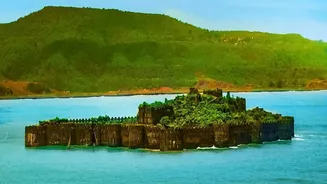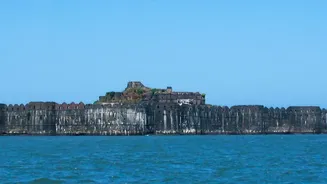




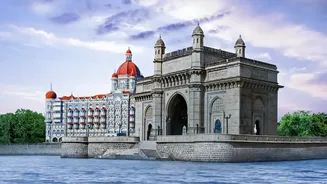
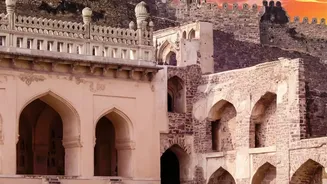
Rising from the Arabian Sea off Maharashtra's coast, the Murud-Janjira fort is an imposing testament to military genius. For centuries, its unique architecture made it unconquerable, a stone sentinel that tells a story of strategy and survival.
The Unconquered Stronghold
Murud-Janjira’s
claim to fame is its undefeated legacy. It is one of the few forts along India’s western coast to have never been conquered in battle. Powerful forces, including the Marathas under Chhatrapati Shivaji Maharaj, the Portuguese, and the British, all made repeated attempts to capture it but failed. Its formidable design and strategic island location made it virtually immune to conventional siege tactics. The fort was originally a small wooden structure built by local Koli fishermen in the 15th century for protection against pirates. Recognizing its strategic value, it was later captured and rebuilt into the formidable stone fortress seen today by Malik Ambar of the Ahmadnagar Sultanate in the 16th century. For centuries, it remained the capital of the Siddis, rulers of Abyssinian descent who established themselves as a powerful naval force.
A Fortress Made by the Sea
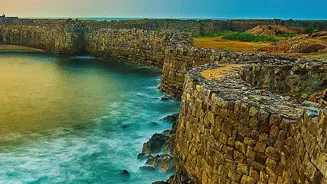
The fort's primary defence is geography itself. Situated on an oval-shaped rock island, it is surrounded entirely by the Arabian Sea, which acts as a natural, impassable moat. This location nullified land-based attacks and made it extremely difficult for enemy ships to approach. The fort's 40-foot-high walls rise directly from the water, leaving no foothold for attackers. This design choice was critical, preventing enemies from mining the walls or using siege engines effectively. The main entrance is a masterpiece of deception; it is concealed within the fortifications and is only visible from a very close distance, making a surprise assault nearly impossible. Any approaching vessel would be exposed to heavy fire from the fort's bastions long before they could locate the gate.
An Engineering Marvel
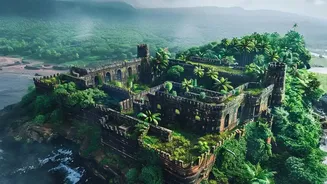
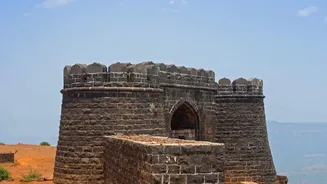
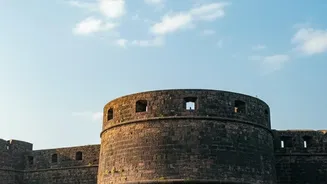
The fort's construction is a marvel of 16th and 17th-century engineering. The structure is fortified with 19 or more rounded bastions, which provided overlapping fields of fire and allowed defenders to cover every possible angle of attack. Many of these bastions still hold the massive cannons that once protected the fort, including famous ones like Kalaal Baangadi, Chavri, and Landa Kasam, which were feared for their range and power. The walls themselves were reportedly constructed from a mixture of stone, jaggery, and limestone, creating a durable structure capable of withstanding both cannon fire and the relentless force of the sea waves.
A Self-Sufficient World Inside
To withstand long sieges, Murud-Janjira was designed as a self-sufficient settlement. One of its most astonishing features is the presence of two large freshwater lakes within the complex, which provided a reliable water source despite the fort being surrounded by saltwater. This feat of engineering was crucial for the survival of its inhabitants during prolonged attacks. In its heyday, the fort was a bustling hub containing all the necessary facilities for a small city, including palaces for the rulers, quarters for officers and soldiers, a mosque, and storage facilities. Secret passages and a hidden rear gate, known as the 'Darya Darwaza' (Sea Gate), provided an escape route to the open sea, further enhancing its defensive capabilities.