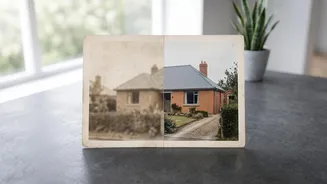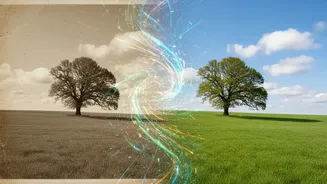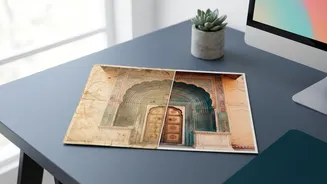




In shoeboxes and forgotten albums lie millions of faded, cracked, and blurry photographs—our windows to the past. Now, a new generation is using powerful and accessible AI tools to breathe new life into these fragile memories.
The Art of Digital Restoration
For years, restoring a damaged
photograph was the exclusive domain of patient professionals who spent hours manually retouching images in software like Adobe Photoshop. This meticulous work involved cloning pixels to cover scratches, painstakingly adjusting colours, and making educated guesses to fill in missing pieces. The process was slow, expensive, and required a high level of skill. Consequently, for most people, the thousands of ageing family photos remained just as they were: beautiful, sentimental, but slowly degrading over time. Traditional digital enlargement often made things worse, stretching a low-resolution image until it became a blurry, pixelated mess.
How AI Learned to See the Past
Modern AI-powered tools have fundamentally changed this equation. Instead of just stretching pixels, these new systems analyse an image and intelligently generate new details. This is made possible by a technology called a Generative Adversarial Network, or GAN. In simple terms, a GAN consists of two competing neural networks: a 'generator' and a 'discriminator'. The generator is trained on millions of pairs of low- and high-resolution images, learning the patterns of everything from skin texture and fabric weaves to the way light hits a strand of hair. It then tries to create a high-resolution version of a new photo, while the discriminator, also trained on real data, tries to spot whether the result is authentic or fake. Through this adversarial process, the generator gets progressively better at creating convincing, detailed restorations until its output is virtually indistinguishable from a real high-resolution photo.
A New Generation of Digital Archivists
This accessible technology has empowered a young generation of creators to become digital archivists for their own families. On social media platforms, a trend has emerged where users share stunning before-and-after videos of restored family photos, turning faded, cracked portraits into sharp, vibrant images. This is about more than just a cool tech trick; it represents a new way of connecting with personal and family history. For a generation that may not have grown up with physical photo albums, these AI tools provide a bridge to the past, making the lives of their parents and grandparents feel more immediate and real. The viral nature of these restorations speaks to a universal desire to preserve memories and pass down a family legacy in a format that's sharp, shareable, and durable.
Your Toolkit for Restoring Memories
Getting started with AI photo restoration no longer requires a degree in computer science. Many powerful tools are now available as user-friendly apps and web services. Tools like Remini are popular for quick mobile-first enhancements, while VanceAI and Fotor offer comprehensive online suites for scratch removal, colourisation, and upscaling. For those exploring genealogy, MyHeritage integrates a powerful photo enhancer directly into its family tree platform. While professional desktop software like Adobe Photoshop now includes its own sophisticated AI-powered 'Neural Filters', many standalone tools offer impressive results with just a single click, making them ideal for casual users.
An Authentic Past or a Perfect Guess?
While the results can be magical, it's important to understand the limitations. AI excels at fixing common issues like scratches, fading, and low resolution because it can analyse the surrounding pixels to make an informed repair. However, when a part of an image is completely missing—like a section of a face—the AI doesn't 'remember' what was there. Instead, it generates a plausible guess based on its training data. This can sometimes lead to 'hallucinations,' where the AI invents details that look realistic but aren't historically accurate. Professionals advise using AI as a powerful tool for the heavy lifting but always reviewing the results with a human eye, especially for historically important or deeply personal images.