




An Ocean World of Possibilities
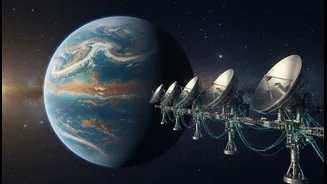
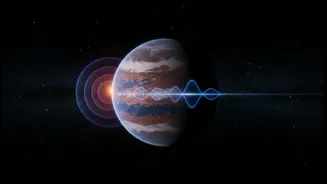
Lying 124 light-years away in the constellation Leo, the exoplanet K2-18b has become a focal point in the search for extraterrestrial life. It is not quite like Earth; it is a 'sub-Neptune', a world larger and more massive than our own, with about 8.6
times Earth's mass. What makes it so special is its location in the habitable zone of its star and evidence from the James Webb Space Telescope (JWST) suggesting it could be a 'Hycean' world. This theoretical class of planet is defined by a deep, global ocean of liquid water underneath a thick, hydrogen-rich atmosphere. Observations have confirmed the presence of carbon-bearing molecules like methane and carbon dioxide, strengthening its profile as a potentially habitable environment.
A Tantalising, Controversial Clue
The excitement around K2-18b skyrocketed when astronomers using the JWST reported tentative evidence of dimethyl sulfide (DMS) in its atmosphere. On Earth, DMS is overwhelmingly produced by life, particularly marine microorganisms like phytoplankton. This made the detection a potential 'biosignature'—a chemical fingerprint of biological processes. However, the scientific community has been rightly cautious. The signal was weak, and several independent analyses of the same data have questioned whether DMS was detected at all, with some researchers suggesting the data is too noisy or that instrumental effects could be at play. Others have pointed out that DMS might be produced by non-biological processes in the unique chemical environment of a hydrogen-rich atmosphere. This debate highlights a core principle of science: extraordinary claims require extraordinary evidence.
Listening for a Different Kind of Signal
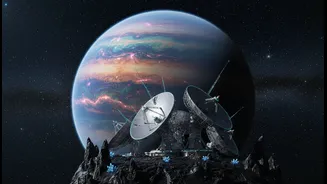
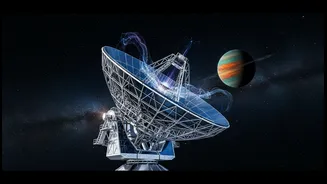
While the JWST looks for chemical biosignatures, a different kind of search focuses on 'technosignatures'—evidence of technology. A recent, massive survey used two of the world's most powerful radio telescope arrays, the Very Large Array (VLA) in New Mexico and MeerKAT in South Africa, to listen for artificial radio transmissions coming from K2-18b. This wasn't a casual listen; it was an extensive campaign designed to hunt for the kinds of narrowband signals that our own technology produces. The project represented one of the most sensitive searches for technosignatures ever conducted for a single planetary system.
The Sound of Scientific Progress
After observing the K2-18b system and sifting through millions of potential signals, the result was a profound silence. The survey found no convincing technosignatures. To get to this conclusion, researchers used a sophisticated, multi-layered filtering process. They automatically masked interference from Earth-based technology, accounted for the signal's expected frequency shift due to planetary and Earth motion, and even used multiple telescope beams to distinguish a true celestial signal from local noise. Any signal that didn't disappear when the planet moved behind its star was also ruled out. Though a null result might sound disappointing, it is incredibly valuable. It rules out a technological civilization broadcasting with power comparable to our own strongest transmitters.
Two Hunts, One Goal
It is crucial to understand that this radio silence does not disprove the potential DMS biosignature. The two searches are complementary, looking for different kinds of life: one for any biology (biosignatures) and the other for intelligent, technological life (technosignatures). The lack of a technosignature helps scientists 'filter false positives' in the broadest sense. It adds a crucial layer of data to the puzzle of K2-18b, reinforcing that natural, non-biological explanations for the JWST's observations must remain the primary focus until more evidence is gathered. This methodical, painstaking process of elimination is not a failure; it is science working exactly as it should.