






Why Your Shoulders Hurt
When you sit at a desk, a subtle but harmful pattern often emerges. You lean forward, your head juts out, and your shoulders round inwards to meet the keyboard. This posture, often called 'tech neck' or 'upper crossed syndrome', creates a muscular imbalance.
The muscles at the front of your body, like your pectorals, become tight and short. Meanwhile, the muscles in your upper back and neck, particularly the trapezius and rhomboids, become overstretched, weak, and fatigued. They are essentially fighting a losing battle against gravity and poor posture all day long. This constant tension is what leads to that familiar burning ache, stiffness, and even tension headaches. The goal of these stretches is to counteract this pattern by opening the chest and gently releasing the overworked muscles in your neck and upper back.
The Neck Side Bend
This simple move targets the upper trapezius muscle, which runs from your neck down to your shoulder and is a major culprit in tension headaches. How to do it: Sit or stand tall with your shoulders relaxed down and away from your ears. Gently tilt your right ear towards your right shoulder, stopping when you feel a light stretch along the left side of your neck. To deepen the stretch, you can rest your right hand gently on your head, but do not pull. Hold for 20-30 seconds, breathing deeply. Slowly return to the centre and repeat on the left side. Perform this 2-3 times on each side. The key is to move slowly and avoid forcing the stretch; it should feel releasing, not painful.
Cross-Body Shoulder Stretch
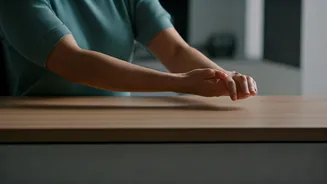
An excellent stretch for the deltoids and the back of the shoulder, this helps release tension built up from typing and using a mouse. How to do it: Stand or sit with a straight spine. Bring your right arm straight across your body, keeping it parallel to the floor. Use your left hand or the crook of your left elbow to gently pull the right arm closer to your chest until you feel a stretch in your right shoulder. It's crucial to keep your shoulder relaxed and down, not hunched up by your ear. Hold this position for 20-30 seconds, ensuring you continue to breathe. Release and repeat with your left arm. This helps improve the flexibility of the shoulder joint and relieves tightness in the posterior capsule.
Doorway Pectoral Stretch
This is the perfect antidote to the rounded-shoulder slump. It opens up the chest muscles (pectorals) which become chronically tight from hunching forward. How to do it: Stand in an open doorway. Place your forearms on the doorframe on either side, with your elbows bent at a 90-degree angle, roughly at shoulder height. Step forward with one foot into the doorway until you feel a gentle stretch across your chest and the front of your shoulders. Keep your core engaged to avoid arching your lower back. Hold for 30 seconds while breathing deeply into the stretch. If you feel any pinching, adjust your arm height or reduce how far you step forward. This is one of the most effective ways to reverse the effects of prolonged sitting.
Seated Cat-Cow
A classic yoga pose adapted for your office chair, the Seated Cat-Cow helps to increase spinal flexibility and release tension in both the upper and lower back. How to do it: Sit on the edge of your chair with your feet flat on the floor and your hands on your knees. On an inhale (Cow pose), gently arch your back, push your chest forward, and look up slightly, rolling your shoulders back and down. On an exhale (Cat pose), round your spine, tuck your chin to your chest, and let your shoulders and head fall forward. Flow between these two positions for 8-10 repetitions, coordinating the movement with your breath. This simple flow mobilises the spine and provides a gentle massage for the muscles supporting it.
Upper Trapezius Release
This targets the very top of your shoulders, where most people carry their stress. It provides a deep, focused release for the upper 'trap' muscles. How to do it: Sit tall in your chair. Drop your right ear toward your right shoulder. Now, gently turn your chin downwards, as if looking towards your right armpit. You should feel a stretch in the back-left side of your neck. To intensify this, you can place your right hand on your head and apply very light pressure, or hold onto the side of your chair with your left hand to anchor the shoulder down. Hold for 20-30 seconds, breathing into the tight spot. Release slowly and switch sides. This is particularly effective for relieving the kind of tension that can lead to headaches.