
The Sun’s Unseen Temper
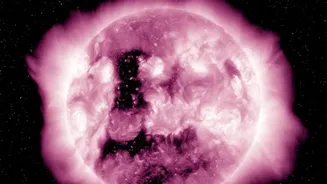
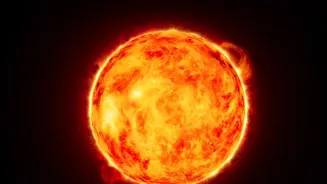
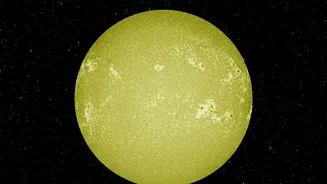
The Sun, our life-giving star, has a volatile side. It periodically releases massive bursts of energy and particles into space. These events, known as solar storms, primarily come in two forms: solar flares and coronal mass ejections (CMEs). A solar flare is
an intense explosion of radiation, while a CME is a giant cloud of magnetised plasma hurled from the Sun at incredible speeds. When these storms are aimed at Earth, they can interact with our planet's magnetic field, creating what is known as a geomagnetic storm. This isn't just a fascinating cosmic light show; it’s a significant threat to our technologically dependent civilisation.
A High-Stakes Threat to Our Digital World
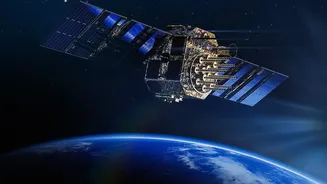
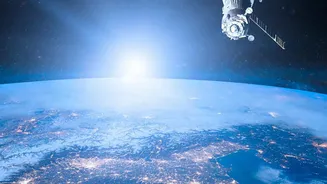
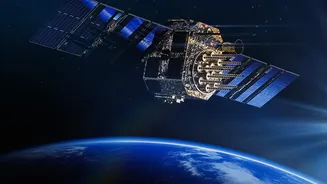
The consequences of a powerful solar storm are far-reaching. In space, charged particles can damage the sensitive electronics of satellites, degrade solar panels, and even alter their orbits by increasing atmospheric drag. This puts our communication, navigation (GPS), and weather forecasting capabilities at risk. On the ground, the danger is just as real. Geomagnetic storms can induce powerful currents in long conductors like power lines. These geomagnetically induced currents (GICs) can flow into electrical grids and overload high-voltage transformers, potentially causing widespread and long-lasting blackouts. The economic impact of such a disruption, affecting everything from banking to transportation, is estimated to be enormous.
Our Global Eyes on the Sun
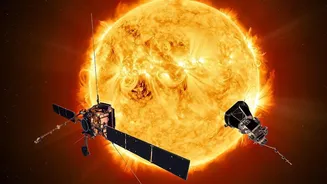
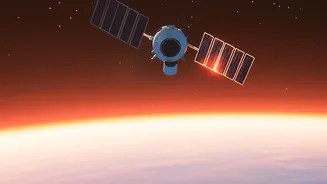
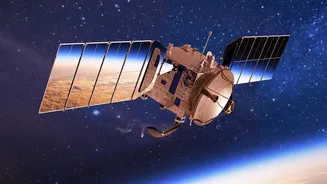
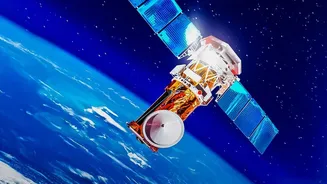
To counter this threat, a global network of observatories, both on the ground and in space, keeps a constant watch on the Sun. Agencies like the US National Oceanic and Atmospheric Administration (NOAA) and the European Space Agency (ESA) operate sophisticated space weather prediction services. NOAA's Space Weather Prediction Center (SWPC) is a key hub, providing forecasts, watches, and warnings to industries worldwide. These services rely on a fleet of spacecraft, such as NOAA's GOES and SOLAR-1 satellites and ESA missions, strategically positioned to monitor the Sun's activity. This international collaboration forms a crucial early-warning system for Earth.
From Prediction to Protection
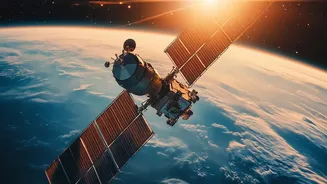
The monitoring process is a race against time. Satellites positioned at a stable gravitational point between the Sun and Earth, called Lagrange Point 1 (L1), act as our forward sentinels. They can detect a CME as it leaves the Sun and measure the speed and density of the incoming solar wind. This data is beamed back to Earth, where forecasters feed it into complex models to predict its arrival time and potential severity. This gives satellite operators, airlines, and power grid managers precious time—from hours to a few days—to take protective measures. Actions can include powering down non-essential satellite components, rerouting flights away from polar regions where radiation is higher, and adjusting loads on power grids to prevent overloads.
India’s Crucial Role in Solar Sentry
India has become a vital player in this global effort with its own solar observatory, Aditya-L1. Launched by the Indian Space Research Organisation (ISRO), Aditya-L1 is also positioned at the L1 point, providing India with a front-row seat to observe solar eruptions in real-time. Data from Aditya-L1's instruments helps Indian scientists measure solar radiation and energetic particles, allowing for more accurate and timely warnings to protect the nation’s critical space and ground infrastructure. The mission has already provided groundbreaking data on recent solar storms, demonstrating India's growing leadership in space science and its importance in the collaborative effort to understand and mitigate space weather.