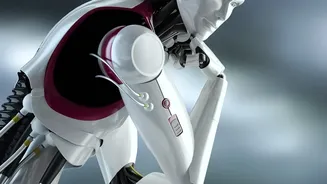








The Mental Muscle You're Not Using
Essential thinking isn't a single skill but a suite of cognitive abilities we rely on daily: critical analysis, independent problem-solving, memory recall, and creativity. These are not innate talents; they are mental muscles built through repetition
and struggle. When you wrestle with a complex problem, you're not just finding a solution; you're forging and strengthening neural pathways. That effortful process is what builds expertise and intellectual resilience. However, the rise of powerful AI tools introduces a tempting shortcut. Instead of grappling with a challenge, we can simply ask an AI to solve it, whether it's drafting an email, writing code, or even generating a business strategy. This process is known as cognitive offloading.
Outsourcing Your Brain to AI
Cognitive offloading is the act of delegating mental tasks to an external tool to reduce cognitive load. We've always done this to some extent, using notepads to remember grocery lists or calculators for complex maths. AI, however, takes this to an entirely new level. It doesn't just hold information; it analyzes, synthesizes, and creates. While this can free up our minds for higher-level thinking, studies suggest that over-reliance has a significant downside. Research has found a strong negative correlation between frequent AI usage and critical thinking abilities. When we consistently bypass the mental work of forming an argument, structuring a report, or brainstorming ideas, we deny our brains the practice needed to maintain and improve these core skills. This can lead to a state of 'cognitive laziness', where we become less inclined to engage in deep, reflective thought.
Real-World Skill Atrophy
The consequences of this mental outsourcing are already becoming apparent. In creative fields like writing and design, there are concerns that an over-reliance on AI-generated content can lead to homogenized, less original work. AI learns from past data, which can inadvertently trap creative processes in the patterns of the past, discouraging the bold, unconventional thinking that drives innovation. In more analytical professions, delegating problem-solving can diminish our ability to tackle novel challenges. A team that depends heavily on AI may struggle when faced with a problem that requires nuanced ethical judgment or a solution that isn't in the training data. Studies indicate that younger individuals, who are often more dependent on these tools, exhibit lower critical thinking scores, suggesting a generational impact.
The Danger of a Smoother Path
The great paradox of AI is that its greatest strength—making tasks easier—is also a significant source of risk. It smooths over the friction and struggle that are essential for deep learning and skill formation. Learning isn't just about getting the right answer quickly; it’s about the process of getting there. When we allow AI to handle too much of this process, we risk becoming passive consumers of information rather than active participants in our own thinking. This dependence can erode confidence in our own judgment, making us vulnerable when AI systems fail or produce the 'hallucinations' they are known for. The ease of getting an answer can weaken our instinct to question, analyze, and verify, skills that are more crucial than ever in an information-saturated world.
Smarter Tools, Smarter You?
The solution isn't to abandon AI. These tools offer incredible benefits for productivity and can automate tedious tasks, freeing us up for more meaningful work. The key is mindful engagement. Instead of asking AI for the final answer, use it as a collaborator or a challenging sparring partner. Start with your own ideas before using AI to refine them. Use it to challenge your assumptions, find holes in your logic, or explore alternative perspectives. Some experts recommend a framework where AI is used to handle low-impact, repetitive tasks (like formatting or summarizing notes) while you reserve your cognitive energy for high-impact, strategic thinking. The goal is to use AI as a co-pilot that augments your intelligence, not an autopilot that replaces it.