

A Landmark Autonomous Landing
The Indian Space Research Organisation (ISRO) has successfully conducted the third and final landing experiment (LEX-03) of its Reusable Launch Vehicle (RLV) technology demonstrator. In the test at the Aeronautical Test Range in Chitradurga, Karnataka,
the winged vehicle, named 'Pushpak', was lifted to an altitude of 4.5 km by an Indian Air Force Chinook helicopter and released. From there, Pushpak flew on its own, autonomously navigating challenging wind conditions, correcting its course, and performing a perfect, high-speed horizontal landing on the runway. It touched down at over 320 km/h before using a brake parachute to slow down, demonstrating its robust autonomous navigation and control systems.
Meet Pushpak: India's Spaceplane
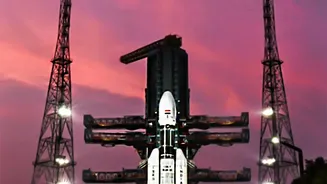
Think of Pushpak as less of a traditional rocket and more of a spaceplane. Unlike conventional rockets that are discarded after a single use, a Reusable Launch Vehicle is designed to fly back to Earth and land on a runway like an airplane, ready to be refurbished and flown again. This ambitious project, officially the RLV-Technology Demonstrator, aims to perfect the key technologies needed for a full-fledged, two-stage-to-orbit (TSTO) launch vehicle. The idea is that a large first stage would carry a smaller, winged second stage (like Pushpak) to a certain altitude before returning to Earth. The second stage would then continue into orbit to deploy satellites before gliding back for its own runway landing.
The Quest for Cheaper Space Access
The single biggest driver behind the RLV program is cost. A significant portion of the expense of a satellite launch—some estimates say up to 80%—is tied to the cost of building the rocket itself. Currently, these expensive rockets are used once and then fall into the ocean. By developing a vehicle whose most expensive components can be recovered and reused, ISRO aims to drastically slash the cost of launching payloads into orbit. The goal is to make space access more economical, not just for ISRO's own missions but also to make India an even more competitive player in the global commercial launch market, which is currently valued in the billions of dollars.
A Greener Approach to Space
Beyond the economic benefits, reusability offers a more sustainable path for space exploration. Every expendable rocket launch leaves behind debris, from spent stages to smaller fragments, that add to the growing problem of 'space junk' in Earth's orbit. This debris poses a significant collision risk to operational satellites and future missions. Reusable vehicles that return to Earth for refurbishment significantly reduce the amount of new debris created with each launch. This aligns with ISRO's broader commitment to safe and sustainable space operations, ensuring that the orbital environment remains usable for future generations.
What’s Next for India’s Spaceplane?
With this successful trio of landing experiments, ISRO has validated the critical autonomous landing technology under challenging conditions. The winged body and flight systems from the second test were reused for this final one, proving the robustness of the design. The next major milestone for the program is the Orbital Re-entry Experiment (ORE). This will involve launching a scaled-up version of Pushpak into orbit on a rocket, letting it spend time in space, and then having it de-orbit and autonomously land back on Earth. While this is a long-term project, each successful test brings ISRO closer to its goal of mastering reusable launch technology and securing India's place as a leading, cost-effective, and sustainable space power.