






A Planet of Paradoxes
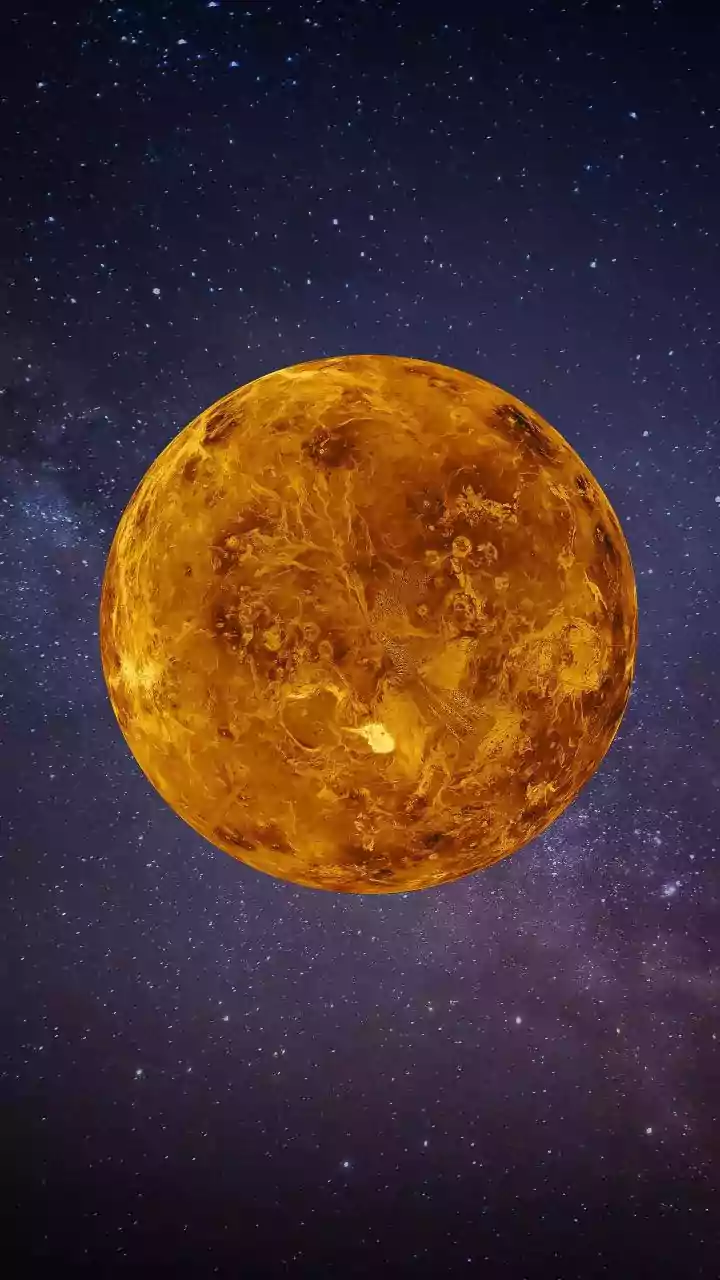
Let's get the mind-bending numbers out of the way first. It takes Venus about 225 Earth days to complete one full orbit around the Sun. This is its 'year.' However, it takes Venus approximately 243 Earth days to rotate just once on its axis. So, a single
Venusian day is about 18 Earth days longer than its entire year. This simple, staggering fact makes Venus a true outlier in our cosmic neighbourhood. While planets like Earth and Mars have days that are a tiny fraction of their years, Venus operates on a completely different, almost impossibly slow timescale. It's a world where you could celebrate your birthday before the sun has even set on the day you were born.
The Two Types of Day
To truly understand this, we need to clarify what we mean by 'day'. There's the sidereal day, which is the time it takes for a planet to complete a 360-degree rotation relative to the distant stars. For Venus, this is the 243-Earth-day period. But there's also the solar day, which is the time it takes for the Sun to return to the same position in the sky (e.g., from one noon to the next). On Earth, these two are very close—a solar day is 24 hours, and a sidereal day is 23 hours and 56 minutes. But on Venus, it’s wildly different. Because Venus spins backward (retrograde), its solar day is actually much 'shorter' than its sidereal day, clocking in at about 117 Earth days. It’s still incredibly long, but this distinction is key to the planet's weird mechanics.
A Slow, Backward Spin
So, why is Venus so peculiar? The first part of the answer lies in its rotation. Unlike Earth and most other planets in our Solar System, Venus spins 'backward' or in a retrograde direction. If you were looking down from above the Sun's north pole, you'd see almost every planet spinning counter-clockwise. Venus, however, spins clockwise. Scientists aren't entirely sure why. One leading theory suggests that a colossal asteroid impact early in its history may have reversed its spin. Another possibility is that the powerful gravitational pull from the Sun and the planet's own thick atmosphere created tidal forces that gradually slowed its rotation over billions of years and eventually flipped its axis.
The Atmosphere's Heavy Hand
The second, and perhaps most crucial, piece of the puzzle is Venus's incredibly dense atmosphere. The air on Venus is about 92 times thicker than Earth's at sea level, creating a surface pressure that would crush a submarine. This atmosphere, composed mostly of carbon dioxide, is in a state of 'super-rotation,' whipping around the planet at speeds over 300 km/h. This creates powerful 'thermal tides'—waves of atmospheric pressure that move across the planet as it's heated by the sun. Recent studies and simulations from agencies like NASA suggest that this atmospheric tide acts like a massive brake, exerting a powerful torque on the solid planet below. Over aeons, this atmospheric drag is believed to have slowed Venus's rotation to its current leisurely pace, locking it into its day-longer-than-a-year state.
Life on a Slow-Boiling World
This extreme rotational period has profound consequences. The long solar day means that one side of Venus faces the Sun for nearly two Earth months at a time, baking under its intense radiation. But because of the runaway greenhouse effect caused by its thick atmosphere, the night side doesn't cool down. The entire planet is shrouded in a blanket that traps heat, maintaining a scorching, uniform surface temperature of around 465° Celsius—hot enough to melt lead. The slow day and crushing atmosphere make Venus the hottest planet in the Solar System, a toxic and inhospitable world that serves as a dramatic example of how planetary evolution can take a very different path from our own.