


A Glimpse into the Cosmic Dawn
For decades, our understanding of the early universe suggested that the first galaxies were turbulent, messy collections of gas and stars. The thinking was that orderly, structured galaxies like our own Milky Way took billions of years to settle down
and form their elegant spiral arms and central features. These ancient galaxies, seen as they were more than 11 billion years ago, are at the very edge of what our technology can perceive. Their light has traveled across the vastness of space and time to reach us, offering a faint but precious snapshot of the universe in its infancy. For a long time, we simply couldn't see them in enough detail to challenge this assumption of primordial chaos.
An Unexpectedly Orderly Past
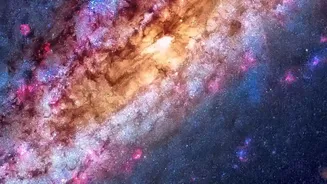
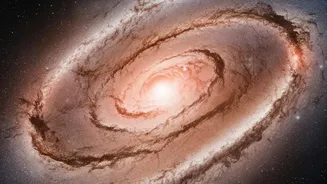
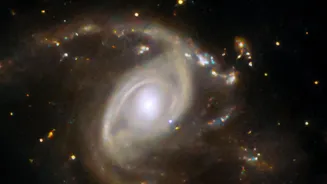
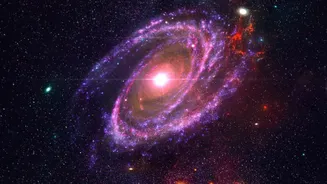
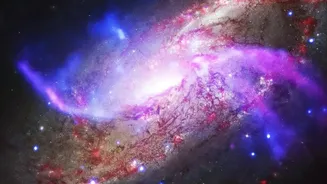
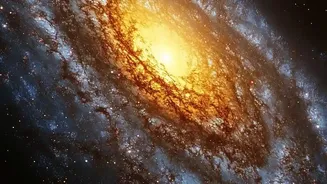
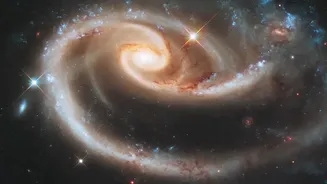
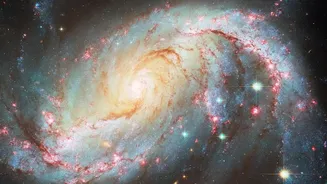
Recent discoveries, however, are painting a very different picture. Astronomers have identified a surprisingly mature barred spiral galaxy, named COSMOS-74706, that existed just two billion years after the Big Bang. This is remarkable because a stellar bar — the dense, elongated structure of stars and gas cutting through the galaxy's center — is considered a feature of a well-evolved, mature galaxy. Our own Milky Way has one. Finding such a sophisticated structure so early in cosmic history suggests that the process of galactic evolution might be much faster than previously thought. It shows that massive galaxies could become dynamically organized very early on.
The Power of New Eyes
This breakthrough was made possible by the unprecedented power of next-generation instruments, most notably the James Webb Space Telescope (JWST). Its incredible sensitivity to infrared light allows it to pierce through the cosmic dust and gas that would otherwise obscure our view of the distant universe. While some earlier observations had hinted at ancient structures, they were often less conclusive. By using a method called spectroscopy to definitively confirm the galaxy's immense distance and age, scientists were able to validate that COSMOS-74706 is one of the earliest, most clearly confirmed barred spiral galaxies ever seen.
Rewriting the Story of Galaxies
The existence of such a complex galaxy so early directly confronts some existing theories. Many models proposed that the gas-rich environments of early galaxies would actually prevent the formation of stable bars. The discovery of COSMOS-74706 and other similar structures forces a rethink. It suggests that the conditions for creating orderly, massive galaxies were in place much sooner than we imagined. These bars are not just cosmetic; they play a crucial role in a galaxy's life, funneling gas toward the center, which can fuel star formation and feed the central supermassive black hole. Their presence indicates that these fundamental evolutionary processes were already underway when the universe was just a fraction of its current age.
Why This Early Maturity Matters
While finding a single advanced galaxy is interesting, it's part of a growing trend of discoveries from JWST that show the early universe was surprisingly developed. Scientists are finding galaxies that are brighter, more massive, and more chemically evolved than expected. This doesn't mean the Big Bang theory is wrong, but it does mean our models of what happened after the Big Bang need significant updates. It appears the young universe was far more efficient at building large, structured galaxies than our theories had accounted for. Each new discovery provides a crucial piece of the puzzle, helping scientists refine the timeline of cosmic evolution and, ultimately, our own origin story.