




An Icy Composition
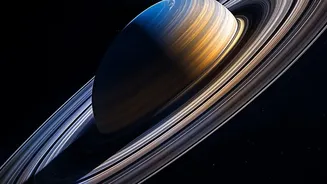
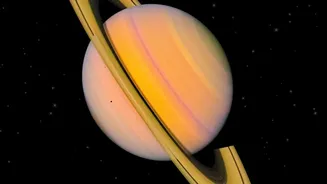
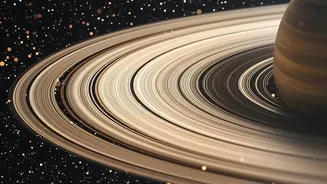
At its simplest, Saturn's rings are made almost entirely of water ice. Data from missions like NASA's Cassini and Voyager have confirmed that the rings are composed of 99.9% pure water ice, with only a tiny fraction made up of rocky material and dust.
This high purity is actually a key clue for scientists trying to determine the age of the rings. From a distance, they look like solid, continuous structures, but they are in fact made of countless individual particles all orbiting Saturn together. If you were to fly through them, you would see a blizzard of icy bodies all around you.
From Dust Grains to Mountains
The particles that make up the rings are incredibly diverse in size. They range from microscopic, dust-sized grains to massive chunks as large as a house or even a mountain. While most particles are the size of small rocks or pebbles, the full range is vast. Imagine a cosmic collection containing everything from grains of sand to city buses, all made of ice and rock, and you have a good picture of the ring system. This mix of sizes contributes to the rings' complex appearance, creating variations in brightness and density that astronomers have labelled as different ring sections, such as the A, B, and C rings.
A Violent and Recent Past
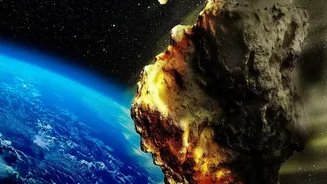
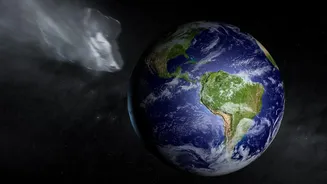
For a long time, it was assumed the rings were as old as Saturn itself, forming 4.5 billion years ago. However, data from the Cassini mission has challenged this idea. The rings are remarkably clean and bright; if they were ancient, they would have been darkened by billions of years of contamination from meteoroid dust. This suggests the rings are much younger, perhaps only 10 to 100 million years old. The leading theory is that the rings are the debris from a cataclysmic event. It's possible that a large, icy moon, or perhaps a passing comet or asteroid, strayed too close to Saturn and was torn apart by the planet's immense gravity. The resulting rubble would have then spread out to form the spectacular rings we see today.
The Disappearing Rings
Just as we've learned that the rings are a relatively new addition, we've also discovered they are temporary. Saturn's powerful gravity is constantly pulling on the icy particles, causing a phenomenon known as 'ring rain'. Electrically charged particles are lifted from the rings and spiral down along the planet's magnetic field lines into its upper atmosphere. Data from the Cassini spacecraft revealed this process is happening faster than anyone expected, pulling tons of material into the planet every second. Scientists estimate that this constant downpour is significant enough that the entire ring system could be gone in as little as 100 million years, a fleeting moment in cosmic time.