

The Case of the Red Potato
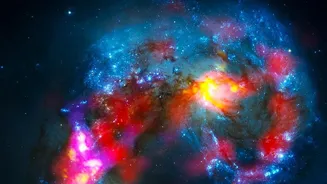
Imagine a garden packed with fertile soil but where no plants will grow. Astronomers have just found the galactic equivalent. In a distant galaxy nicknamed the “Red Potato,” officially known as PLCK G244.8+54.9, scientists were puzzled. It was full of the cool
gas needed to form new stars, yet star production had mysteriously stalled. Fresh observations from Japan’s XRISM X-ray spacecraft have finally solved the mystery, and the culprit is a cosmic monster. The galaxy’s central supermassive black hole is blasting out powerful jets of energy. This process, known as “black hole feedback,” is so violent that it heats up and churns the gas, preventing it from collapsing to form new stars. In effect, the black hole is single-handedly shutting down its own galaxy’s ability to grow.
A Black Hole on the Run
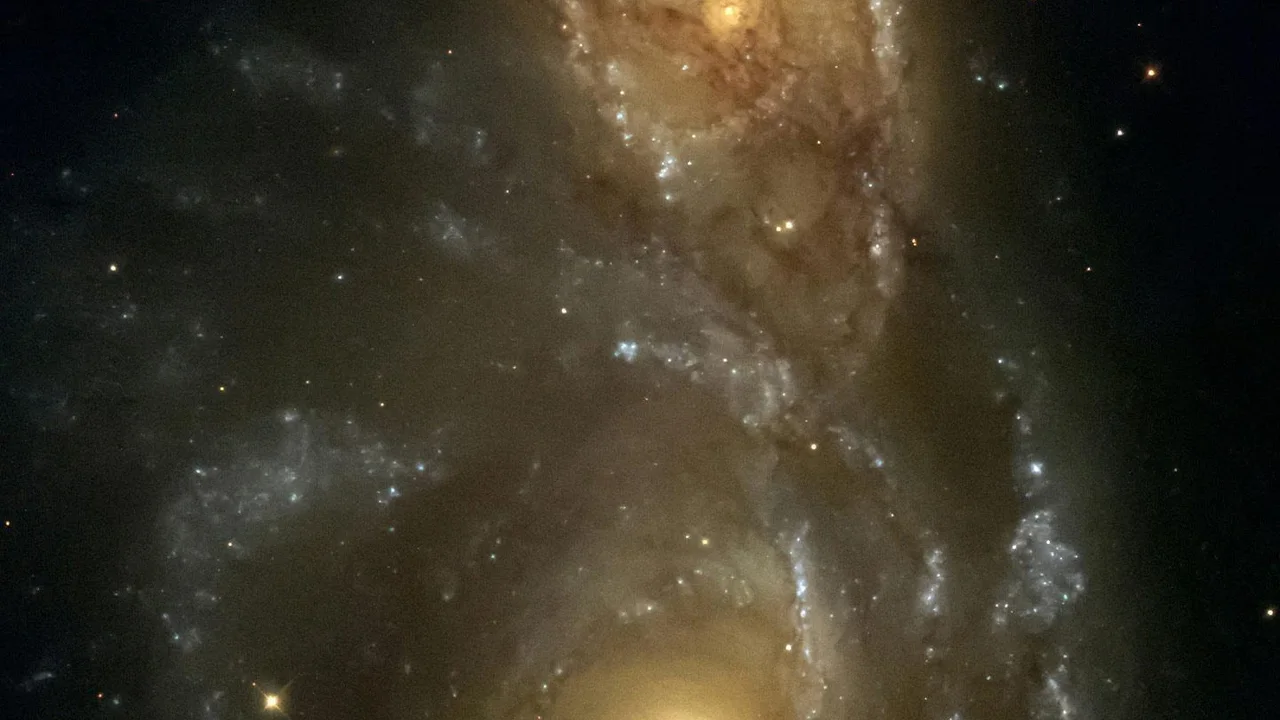
One of the textbook rules of astronomy is that supermassive black holes live at the centre of large galaxies. But recent observations have just found one that seemingly didn't get the memo. Using multiple observatories, including NASA's Swift, astronomers detected a flash of light from the outer edge of a galaxy 750 million light-years away. This wasn't a supernova, but the tell-tale flare of a star being torn apart by a black hole — a “tidal disruption event.” The shocking part is its location. Discovering a dormant, wandering black hole so far from the galactic core is a first. Scientists theorise that this million-solar-mass object was originally at the centre of a smaller galaxy that merged with the larger one, getting flung out into the suburbs in the process. It's a dramatic confirmation of how chaotic and dynamic galaxy mergers can be.
Galaxies That Shouldn't Exist
Perhaps the most profound revelations are coming from the James Webb Space Telescope (JWST). Webb was designed to see the universe's first galaxies, formed just a few hundred million years after the Big Bang. And it has found them — but they are not what anyone expected. Many of these cosmic infants appear far too mature. They are brighter, more massive, and more chemically complex than our models predicted was possible so early in cosmic history. Looking back in time to an era when the universe was just 2% of its current age, astronomers are finding galaxies that already contain elements like nitrogen, which were thought to take billions of years to produce. These “impossible” galaxies are forcing scientists to completely rethink how quickly the first stars ignited and how rapidly the first galaxies could assemble themselves in the cosmic dawn.
New Eyes, New Universe
These seemingly separate discoveries are connected by a single theme: we are seeing the universe in a completely new light. Instruments like the JWST see in infrared, allowing it to peer through dust clouds and look back to the beginning of time. XRISM sees the cosmos in high-energy X-rays, revealing the violent actions of black holes. Together, these different views are creating a multi-layered understanding that was previously impossible. The unseen is becoming visible. What we once thought were simple rules about galactic evolution are being replaced by a more complex and fascinating picture, filled with rogue black holes, self-sabotaging galaxies, and cosmic structures that grew up far too fast. These fresh observations aren't just adding footnotes to our textbooks; they are forcing us to write entirely new chapters.