



A Day Longer Than a Year
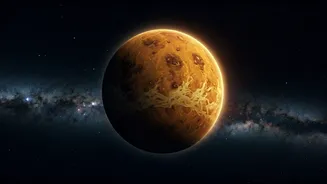
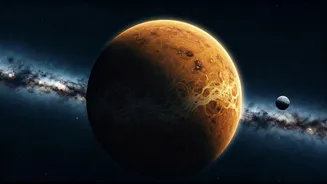
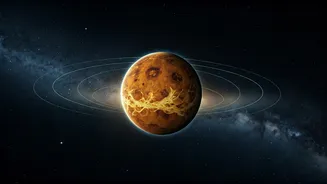
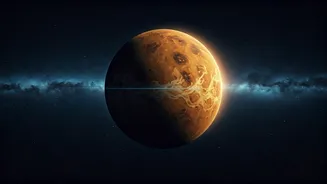
Let’s get the mind-bending numbers out of the way first. It takes Venus about 225 Earth days to complete one full orbit around the Sun. This is its year. Simple enough. However, it takes the planet a staggering 243 Earth days to complete just one rotation
on its axis. This is its sidereal day—the time it takes to spin 360 degrees. So, if you were standing on Venus, you would finish celebrating a full New Year's cycle before the planet had even finished spinning once. This makes Venus unique in our solar system; it’s the only planet where a day is longer than a year. It’s a fundamental characteristic that sets the stage for a host of other planetary oddities.
And It Spins the Wrong Way
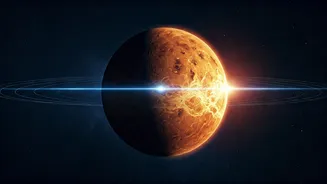
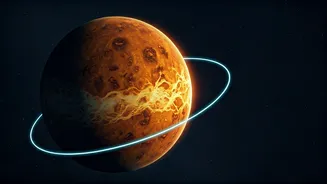
As if being incredibly slow wasn’t enough, Venus also spins backward. With the exception of Uranus, which is tilted on its side, every other planet in our solar system rotates counter-clockwise on its axis, the same direction they orbit the Sun. But not Venus. It has what’s known as retrograde rotation, spinning lazily in a clockwise direction. This means that if you could survive on its surface, you would see the Sun rise in the west and set in the east. This backward, sluggish spin is a massive clue for scientists trying to piece together the planet's violent and mysterious past. Something, or some force, long ago knocked Venus completely out of sync with its planetary siblings.
Why So Slow and Backwards?
Scientists don't have a single definitive answer, but two leading theories attempt to explain Venus’s bizarre behaviour. The first is the 'giant impact' theory. In the chaotic early days of the solar system, it’s possible that a massive planet-sized object slammed into a young Venus. Such a cataclysmic collision could have not only slowed its original spin to a crawl but also completely reversed its direction. A similar impact is thought to have created our Moon and tilted Earth on its axis. The second major theory involves Venus’s crushingly dense atmosphere. Its atmosphere is 90 times thicker than Earth’s and whips around the planet at high speeds. Some models suggest that powerful atmospheric tides have created a drag on the planet over billions of years, acting like a brake that gradually slowed its rotation and may have even helped flip it over.
The Weirdest Sunrise in the Solar System
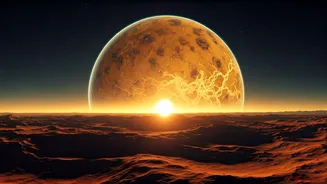
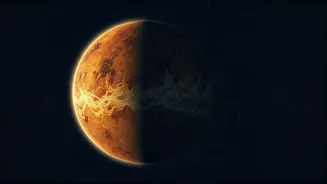
The combination of its slow, backward rotation and its relatively quick orbit creates another strange effect. While a full 360-degree spin (sidereal day) takes 243 Earth days, the time from one sunrise to the next (solar day) is much shorter, at around 117 Earth days. How? Because Venus is moving around the Sun as it spins. Its orbital motion 'catches up' to its backward rotation, making the Sun appear to cross the sky more quickly than the planet's actual spin would suggest. This still means you’d have about two months of daylight followed by two months of darkness—a recipe for the extreme temperatures seen on the planet’s surface, which hover at a scorching 465°C, hot enough to melt lead.
Earth's Twisted Sister Planet
Venus is often called Earth's twin because it’s similar in size, mass, and composition. But its rotation is a stark reminder of how these two worlds took drastically different evolutionary paths. Understanding why Venus became a scorching, high-pressure hellscape with a bizarre spin is crucial for planetary scientists. It provides a natural experiment, showing what can happen to a terrestrial planet under different conditions. By studying the forces that shaped Venus—be it ancient impacts or runaway atmospheric effects—we gain invaluable context for the delicate balance of factors that have allowed Earth to remain a habitable oasis in our solar system.