




The Cosmic Speed Limit
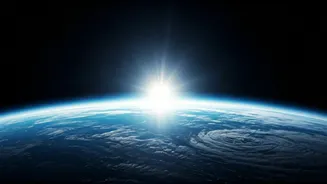
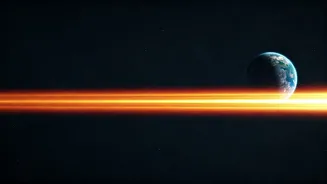
The feeling of sunlight on your skin is the result of photons—tiny packets of light energy—completing a journey of roughly 150 million kilometres. While light is the fastest thing in the universe, it’s not instantaneous. It travels at a blistering pace
of approximately 300,000 kilometres per second. When you do the maths, dividing the distance by the speed, you get a travel time of about 500 seconds. That translates to 8 minutes and 20 seconds. So, every ray of sunshine you experience, every sunrise you witness, is an image of the Sun as it was more than eight minutes ago. You are, in a very real sense, always looking at the Sun’s past.
A Journey in Light-Minutes
This delay isn't a bug in the system; it's a fundamental feature of our universe. The distance from the Earth to the Sun is so significant that astronomers use this travel time as a form of measurement. This distance is called an Astronomical Unit (AU), but it can also be described as 8.3 light-minutes. This concept of measuring distance by the time it takes light to travel is crucial in astronomy. It helps us grapple with the incomprehensible vastness of space. For instance, light takes about 1.3 seconds to travel from the Moon to Earth. When you look at the Moon, you're seeing it as it was just over a second ago. From Mars, at its closest approach, light can take over three minutes to reach us. Each celestial body we see is a snapshot from its own recent past.
The Universe as a Time Machine
This effect becomes truly mind-bending when we look beyond our solar system. The nearest star to us, Proxima Centauri, is about 4.2 light-years away. This means the light we see from it tonight left that star 4.2 years ago. When you gaze at it, you're not seeing the star as it is right now; you're seeing it as it was when the 2020 Olympics were being held in Tokyo. Go further out, and the time-travel effect becomes even more dramatic. The Andromeda Galaxy, our closest major galactic neighbour, is 2.5 million light-years away. The light hitting your eyes from Andromeda began its journey when early human ancestors were first roaming the Earth. Every telescope is a time machine, and the simple act of looking at the night sky is an act of looking into the deep past.
What If the Sun Disappeared?
Here’s a classic thought experiment that drives the point home. If the Sun were to suddenly and magically vanish, what would happen on Earth? For 8 minutes and 20 seconds, absolutely nothing. We would continue to orbit a ghost, basking in the light of a star that was no longer there. The sky would remain bright, the warmth would still be on our skin. Only after those crucial minutes passed would darkness fall and gravitational effects cease. It’s a slightly unsettling thought, but it perfectly illustrates that we are fundamentally disconnected from the 'now' of the cosmos. We live in a bubble of delayed information, constantly receiving old news from the universe.