




First, What Exactly is a Quasar?
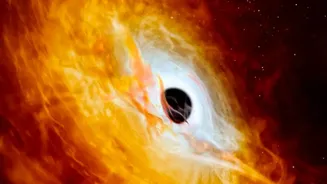
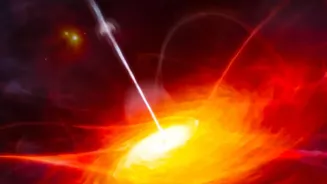
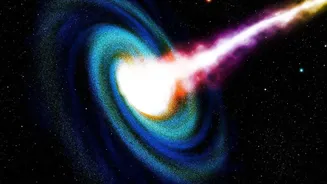
Before we get to the discovery, let's talk about quasars. The name is short for 'quasi-stellar object'. Think of a supermassive black hole at the center of a young galaxy. Now, imagine that black hole feasting on a massive buffet of gas, dust, and stars.
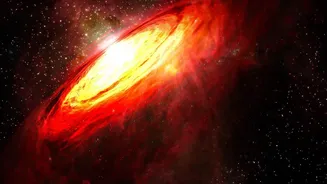
As this material spirals into the black hole, it forms a super-heated, intensely bright 'accretion disk'. This disk gets so hot and luminous that it can outshine all the billions of stars in its own galaxy combined. These incredibly bright, distant objects are what we call quasars. They are like cosmic lighthouses, allowing us to see back to the very earliest epochs of the universe.
A Record-Breaking Discovery
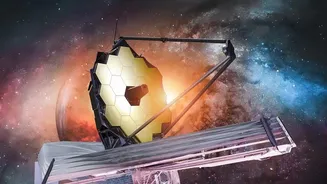
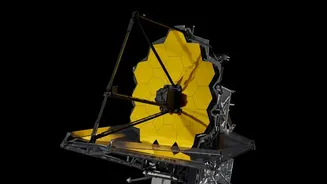
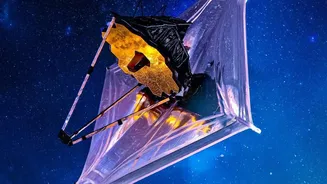
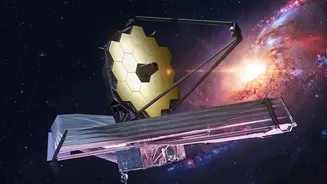
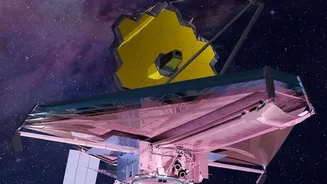
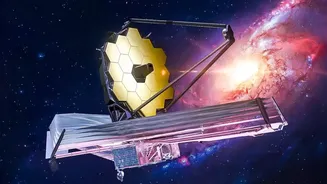
Using the powerful infrared vision of the JWST and the Gemini North telescope in Hawai'i, astronomers have identified the most distant and oldest compact pair of quasars ever seen. The system, nicknamed Nāpōwawāʻenakaulua, is seen as it was just 900 million years after the Big Bang, during a period called the 'cosmic dawn'. This discovery is remarkable not just for finding one quasar, but two, shining brightly in close proximity to each other at such an early point in cosmic history. The pair are separated by about 18,100 light-years—a tiny distance in cosmic terms, roughly one-fifth the diameter of our own Milky Way galaxy.
Why Two is a Big Deal
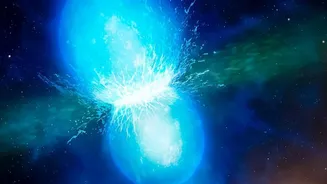
Finding a single quasar from this early is already a puzzle for scientists. But finding a pair so close together suggests something profound about the early universe. The leading theory is that this pair of quasars represents two massive galaxies in the process of merging. Such mergers are thought to be the primary way large galaxies are built. The intense gravitational interactions would have funneled enormous amounts of gas toward each galaxy's central black hole, igniting them both as quasars simultaneously. This discovery provides a stunning, real-world snapshot of a process that, until now, has been largely theoretical for this early era, offering a unique laboratory to study how the first massive galaxies and their black holes grew together.
Challenging Our Understanding of Time
The existence of these two quasars so early in the universe presents a major challenge to current models of black hole growth. The black holes powering this pair are enormous, with estimated masses of 1.5 billion and 400 million times that of our sun. According to standard theories, there simply shouldn't have been enough time since the Big Bang for black holes to grow this massive this quickly. Finding two of them together suggests that the processes of galaxy mergers and black hole growth in the primordial universe happened much faster and more furiously than previously assumed. The JWST continues to show us that the early universe was a far more active and developed place than we once imagined.
So, Are They Dangerous?
Now, let's address the 'danger' part of the headline. While a quasar would be incredibly destructive if it were nearby, the key word is 'nearby'. If a quasar were as close as Pluto, its radiation could boil our oceans. However, all known quasars are features of the very distant, early universe. This newly discovered pair is seen as it was over 12 billion years ago; their light has been traveling across the expanding universe to reach us. They are incredibly far away and pose absolutely no threat to Earth or our galaxy. They are not a sign of impending doom but a postcard from the distant past, offering invaluable insights into our cosmic origins.