






Rethinking Your Morning Cardio
Let's be clear: any movement is good movement. The morning jog or session on the elliptical has its place. But for many, steady-state cardio can become a plateau. It’s time-consuming, can be tough on the joints, and while it improves heart health, it does
little for building functional strength or improving mobility. The headline says 'ditch', but let’s think of it as an 'upgrade'. What if you could get your cardio fix while also forging a more resilient, powerful body in half the time? That's where kettlebells come in. They challenge your muscles and your heart simultaneously, forcing your body to adapt and grow stronger in a way that jogging on a flat surface simply can’t match.
The Kettlebell Advantage
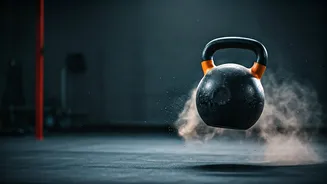
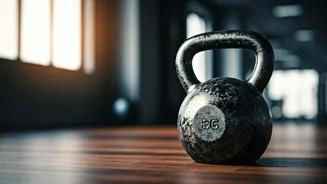
A kettlebell is essentially a cannonball with a handle, and its unique shape is its secret weapon. Unlike a dumbbell, the kettlebell's centre of gravity is offset, located several inches away from your grip. This forces your stabiliser muscles—in your core, back, and shoulders—to work overtime just to control it. The result? A full-body workout from a single piece of equipment. Kettlebell training is ballistic, meaning it involves explosive movements like swings and snatches. This builds power and athleticism. It’s also a form of metabolic conditioning, skyrocketing your heart rate and torching calories in short bursts, delivering cardiovascular benefits that rival and often exceed those of traditional cardio.
What Exactly is a Mobility Flow?
A mobility flow is about seamlessly connecting a series of movements into a graceful, continuous sequence. Think of it as yoga's powerful cousin. Instead of holding static poses, you are constantly in motion, 'flowing' from one exercise to the next. When you add a kettlebell, this becomes a dynamic practice that challenges your strength, balance, coordination, and focus. A morning flow isn’t just a workout; it's a moving meditation. It wakes up your nervous system, lubricates your joints, and prepares your body and mind for the day ahead. You’re not just mindlessly counting reps; you’re focused on the quality and grace of each transition, which makes the workout far more engaging.
The 15-Minute Morning Kettlebell Flow
This simple but brutally effective flow combines three fundamental movements. The goal is not speed, but perfect form and a smooth transition between exercises. Perform the entire sequence on one side before switching to the other. Aim to complete as many rounds as possible (AMRAP) in 15 minutes, resting only as needed. 1. The Halo (5 reps): Stand with feet shoulder-width apart, holding the kettlebell by its 'horns' (the sides of the handle) upside down at your chest. Slowly circle the kettlebell around your head, keeping your core tight and your torso still. Alternate direction with each rep. This is for shoulder mobility. 2. Goblet Squat (5 reps): From the chest position, hold the kettlebell upright. Keeping your chest up and back straight, squat down as if sitting in a chair, going as deep as your mobility allows. Drive through your heels to return to the start. This works your legs and core. 3. Two-Handed Swing (10 reps): This is the engine of the workout. With feet slightly wider than shoulder-width, hinge at your hips (don't squat). Hike the kettlebell back between your legs, then explosively drive your hips forward to 'float' the kettlebell up to chest height. Let gravity bring it back down into the next rep. The power comes from your hips, not your arms. Flow: Perform 5 halos, 5 goblet squats, and 10 swings. That's one round. Rest briefly, then repeat.
Getting Started Safely
The most important part of kettlebell training is safety. Form is everything. Start with a light weight to master the movements. A good starting point for men is often 12-16 kg, and for women, 8-12 kg. If you are a complete beginner, even lighter is better. Do not use your arms or back to lift the weight during a swing; the power comes from an explosive hip hinge. If possible, watch videos from a certified instructor (like those from StrongFirst or RKC) or consider a session with a local certified trainer. Listen to your body. It's better to perform five perfect reps than 20 sloppy ones that could lead to injury. Focus on mastering the basics before you increase weight or complexity.