




The Ghost Particle
Trillions of neutrinos pass through your body every second. These fundamental particles are born from some of the most violent events in the cosmos, including exploding stars and the churning hearts of galaxies. Because they have almost no mass and no electric
charge, they barely interact with matter, earning them the nickname 'ghost particles'. This quality makes them perfect cosmic messengers; unlike light, they can travel billions of light-years from their source without being absorbed by dust or bent by magnetic fields. However, this same elusiveness makes them incredibly difficult to trace. For decades, scientists knew these high-energy particles were arriving at Earth, but pinpointing their exact origin was a profound mystery.
A Giant Trap in the Ice
To catch a ghost, you need a special kind of trap. At the South Pole, scientists built the IceCube Neutrino Observatory, a massive telescope unlike any other. It doesn't use mirrors or lenses. Instead, it uses a cubic kilometre of pristine Antarctic ice. Over 5,000 light sensors are embedded deep within this ice, waiting patiently for a rare event: a neutrino striking an atom in an ice molecule. When this happens, it creates a faint flash of blue light. By analysing the pattern and timing of this light, scientists can reconstruct the neutrino's path through the ice, estimating its energy and, crucially, the direction from which it came.
The 'Shadow Blaster' Appears
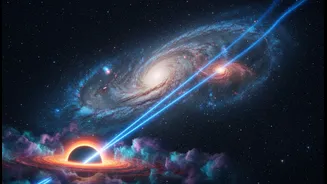
In September 2021, IceCube detected a particularly high-energy neutrino, catalogued as IC 210922A. An alert was sent to astronomers worldwide to scan that patch of sky for a possible source. At first, they found nothing—no exploding star, no dramatic flare from a black hole. Then, a team looked at longer wavelengths of light, the kind that can see through thick cosmic dust. There, they found a galaxy, officially named JCMT0402−0424, that was faint in visible light but glowing intensely in the submillimeter spectrum. Because it was so bright yet so hidden, scientists nicknamed it the 'Shadow Blaster.' It was a prime suspect, a powerful source hiding behind a veil of dust, perfectly capable of launching a particle that could blast through its own shadow.
A Cosmic Engine of Creation
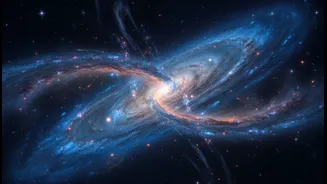
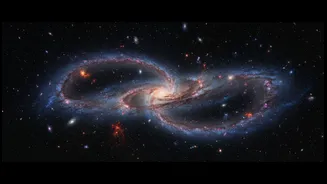
The Shadow Blaster is a special type of galaxy known as a 'starburst galaxy.' Located about 11 billion light-years away, we see it as it was during an era of the universe called 'cosmic noon', when star formation was at its peak. These galaxies are cosmic nurseries on an extreme scale, forming stars at a rate hundreds of times faster than our own Milky Way. This frantic pace of star birth creates a chaotic environment, with massive stars exploding as supernovae. These explosions can accelerate particles like protons to incredible speeds. When these high-speed particles collide with the dense gas in the galaxy, they produce high-energy neutrinos. Scientists believe the Shadow Blaster's extremely compact and gas-rich core is the perfect engine for this process, a true neutrino factory.
A New Window on the Universe
Connecting this single neutrino to the Shadow Blaster galaxy is a landmark achievement. While scientists had previously linked neutrinos to galaxies with active supermassive black holes, this is one of the strongest pieces of evidence linking them to a galaxy powered primarily by intense star formation. It suggests that this type of dusty, compact starburst galaxy could be responsible for a significant portion of the high-energy neutrinos detected across the universe. This discovery helps solidify the field of neutrino astronomy, a new way of observing the cosmos. By studying neutrinos alongside light and gravitational waves, we can get a more complete picture of the most energetic and hidden processes that shape our universe, from its violent youth to the present day.