


The Sleeping Giants of the Cosmos
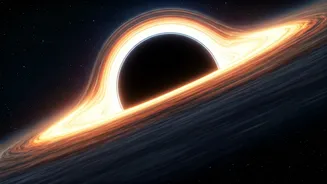
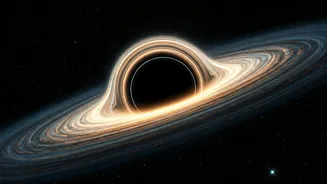
At the heart of most large galaxies, including our own Milky Way, lies a supermassive black hole, an object with millions or even billions of times the mass of our sun. For the most part, these cosmic titans are dormant. They aren't actively gobbling
up huge amounts of matter, so they don't give off much light, making them difficult to see directly. They are like sleeping giants, their immense gravitational presence shaping their host galaxies, but otherwise remaining quiet. Scientists have long known that these black holes exist, but observing a dormant one is challenging because they are effectively invisible without the bright glow of infalling material.
A Sudden and Violent Awakening
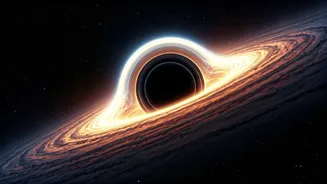
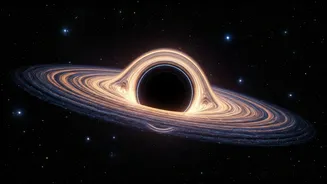
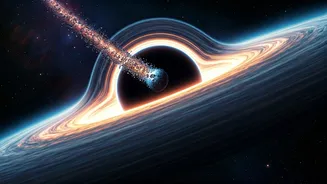
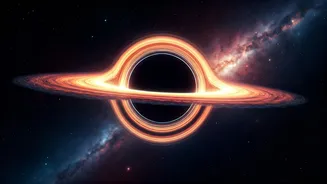
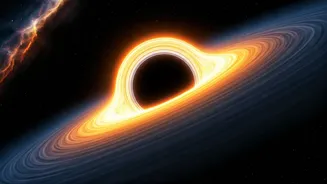
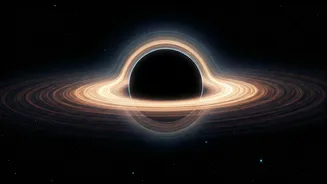
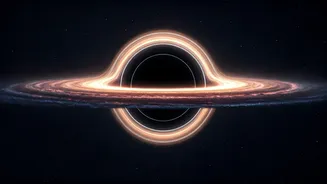
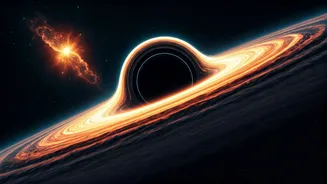
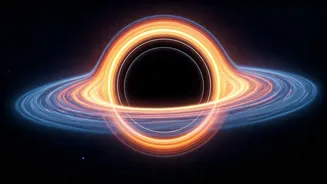
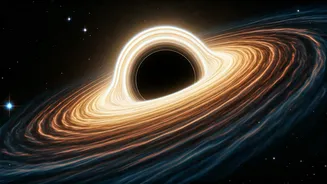
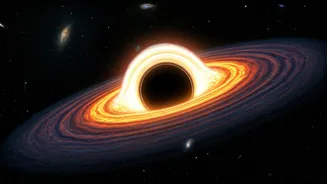
A black hole “wakes up” when something ventures too close and gets caught in its gravitational grip. Often, this is a star that has wandered off course. In an event known as a tidal disruption event (TDE), the black hole's immense tidal forces stretch and pull the star apart in a process sometimes called 'spaghettification'. This stellar material then forms a swirling, superheated disc of gas and dust around the black hole, known as an accretion disk. As this material spirals inward, it releases an enormous amount of energy, causing the previously dark galactic center to light up dramatically across the electromagnetic spectrum.
Decoding the Radiations
The awakening of a black hole is not a quiet affair. It announces itself with a brilliant flare of radiation, including powerful X-rays, ultraviolet light, and radio waves. This burst of energy is what astronomers detect as a 'transient event'—a sudden brightening in a location that was previously dim. In late 2019, for instance, astronomers witnessed the core of a galaxy called SDSS1335+0728, about 300 million light-years away, suddenly begin to shine brighter than ever before. This event was unprecedented because, unlike a supernova or a typical TDE that fades in a few hundred days, this galaxy has continued to brighten for years, giving scientists the first real-time look at a black hole 'switching on'.
Cosmic Clues from the Chaos
These energetic outbursts are far more than just cosmic fireworks; they are a treasure trove of information. By studying the light and radiation from a waking black hole, scientists can perform cosmic forensics. The properties of the radiation reveal details about the black hole's mass and spin. Furthermore, the emissions act as a probe, illuminating the material being consumed and offering insights into the composition of the shredded star or gas cloud. Observing these events in real time allows astronomers to test their models of how black holes feed and grow, a fundamental process tied to the evolution of galaxies themselves. The powerful winds and jets launched from these feeding black holes can even influence star formation throughout the host galaxy, sometimes blowing away the gas needed to form new stars.
A New Era of Black Hole Astronomy
Recent observations have challenged previous assumptions. An event nicknamed 'Ansky' in a galaxy 300 million light-years away has produced bursts of X-rays that are 100 times more energetic than typical quasi-periodic eruptions seen from other black holes. This has forced a re-evaluation of how these giants behave as they emerge from dormancy. With advanced telescopes constantly scanning the skies, we are moving into an era where we don't just know about dormant black holes, but we can watch them wake up. Each new event provides a unique natural laboratory for studying the most extreme physics in the universe, helping us piece together the life cycle of galaxies and the cosmic monsters at their centers.