
A Universe of Extreme Weather
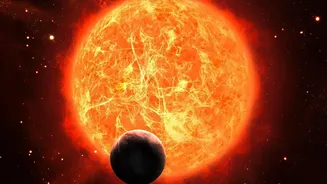
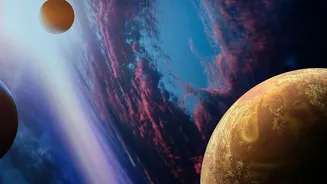
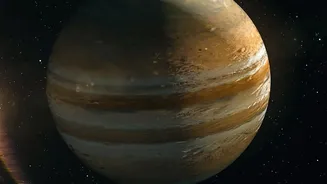
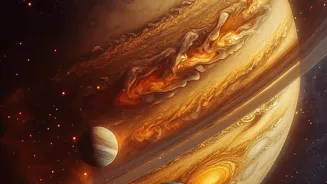
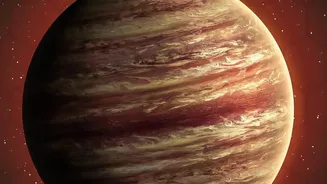
Our galaxy is filled with planets of incredible diversity, many of which make the most extreme environments on Earth seem tame. Much of the focus is on 'hot Jupiters,' gas giants that orbit perilously close to their parent stars. One side of these planets is often
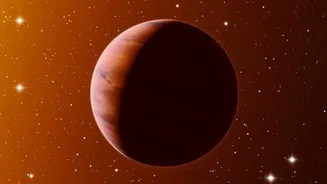
permanently locked facing the star, creating a blistering 'dayside' with temperatures that can climb above 2400 degrees Celsius. This is hot enough to vaporise rock and metals like iron. The other side, the 'nightside,' is in perpetual darkness and comparatively cooler, though still incredibly hot by our standards. This extreme temperature difference between the two hemispheres is the engine for some of the most violent weather systems imaginable.
The Starlight Detective Method
Scientists can't see this weather directly, but they can be clever detectives. The primary method they use is called transit spectroscopy. It works when an exoplanet passes, or 'transits,' in front of its host star from our point of view. As the starlight shines through the edge of the planet's atmosphere, some of that light is absorbed by the atoms and molecules present. Each chemical element absorbs light at very specific colours or wavelengths, creating a unique 'barcode' or 'fingerprint' in the star's light spectrum. By capturing the starlight before and during a transit, astronomers can isolate the light that has passed through the atmosphere and analyse this barcode to see what the atmosphere is made of.
Decoding the Chemical Barcode
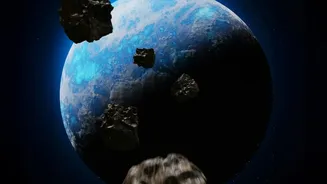
This atmospheric barcode is the key to discovering alien rain. On the exoplanet WASP-76b, a hot Jupiter located about 640 light-years away, scientists used this technique to look for iron. Using powerful spectrographs like the ESPRESSO instrument on the European Southern Observatory's Very Large Telescope, they studied the light from the planet's 'evening' edge, where the atmosphere rotates from the hot dayside to the cool nightside. There, they detected the strong chemical signature of iron in a gaseous state. However, when they looked at the 'morning' edge, where the atmosphere emerges from the nightside, the iron signature was gone. The conclusion was astonishing: the iron vapor is carried by strong winds to the cooler nightside, where it condenses into liquid droplets and falls as iron rain.
Catching Supersonic Winds
Detecting wind speed requires another layer of ingenuity, this time using the Doppler effect. You experience this when an ambulance siren's pitch changes as it moves towards and then away from you. The same principle applies to light. If a gas in an exoplanet's atmosphere is moving towards us, its light signature shifts to the blue end of the spectrum; if it's moving away, it shifts to the red. By using high-resolution spectroscopy, astronomers can measure these tiny shifts in the atmospheric barcode. On a planet like HD 189733b, scientists measured the blueshift on one side of the planet and the redshift on the other. This allowed them to calculate that wind was blowing from the dayside to the nightside at over 8,700 km/h—more than seven times the speed of sound.
The Future of Alien Weather Reports
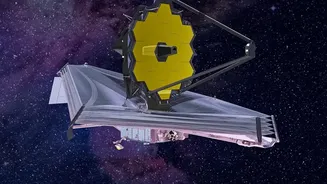
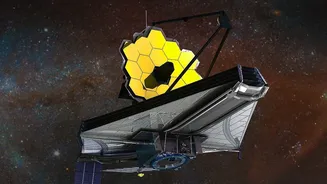
These techniques are constantly being refined. Powerful instruments like the James Webb Space Telescope (JWST) are providing an even clearer view of exoplanet atmospheres, allowing scientists to create more detailed chemical profiles and weather maps for these distant worlds. Ground-based telescopes are also becoming more precise, offering cost-effective ways to conduct initial surveys of planetary atmospheres. By combining high-resolution spectroscopy with an understanding of atmospheric physics, scientists can now go beyond just discovering planets and begin to truly characterise their environments, no matter how alien they might be. It’s the art of remote weather forecasting on a galactic scale.