



What You'll See in the Sky
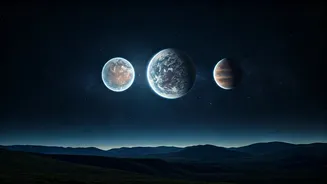
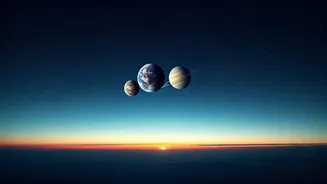
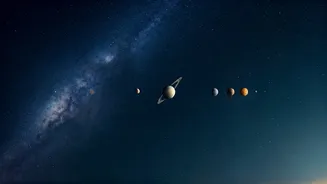
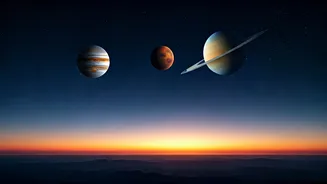
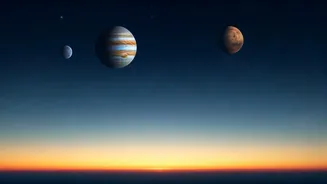
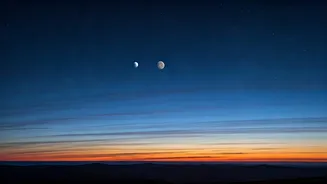
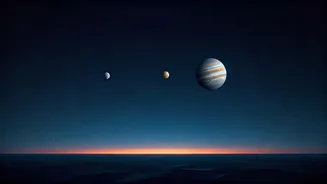
Tonight, you’ll have the chance to see a planetary trio: Jupiter, Mars, and Saturn. While they are millions of kilometres apart in space, from our perspective on Earth, they will appear to form a graceful line in the sky. Jupiter, the largest planet in our solar
system, will shine as the brightest point of light. Mars will be identifiable by its distinct reddish-orange glow, a characteristic that has earned it the name 'the Red Planet'. Saturn, famous for its rings (though you'll need a telescope to see them), will appear as a steady, yellowish-white point of light, typically fainter than Jupiter but still clearly visible. This isn't a once-in-a-lifetime event, but it's a beautiful and serene alignment that makes for a perfect, easy stargazing opportunity.
When and Where to Look
Timing and direction are key. The best time to look is shortly after sunset, during the twilight hour. Aim to be looking about 30 to 90 minutes after the sun has completely dipped below the horizon. This is when the sky is dark enough for the planets to pop out, but before they sink too low towards the horizon themselves. You’ll want to face the western sky—the same direction where the sun just set. The planets will be relatively low, so find a spot with an unobstructed view of the western horizon. A balcony, terrace, or a nearby park away from tall buildings and trees would be ideal. As the night progresses, they will appear to move across the sky and set, so the early evening is your prime window.
Do You Need a Telescope?
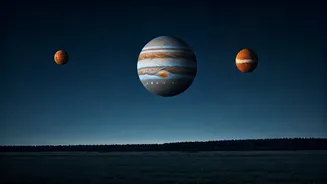
Absolutely not! This planetary display is a naked-eye event. All three planets—Jupiter, Mars, and Saturn—are among the five planets that have been observed by humans for millennia without any optical aid. Their brightness makes them easily stand out from the surrounding stars. However, if you have a pair of binoculars, you’ll get an even better view. Binoculars will make the colours more vibrant, especially the red of Mars. If you look closely at Jupiter, you might even be able to spot its four largest moons (the Galilean moons) as tiny pinpricks of light flanking the planet. A small telescope, of course, would elevate the experience further, potentially revealing Saturn’s iconic rings or the cloud bands of Jupiter. But for simply enjoying the alignment, all you need are your eyes.
Tips for the Best Viewing Experience
To make the most of this celestial sight, a little preparation goes a long way. First, try to get away from bright city lights. Light pollution washes out the night sky, making it harder to see fainter objects. Even moving to a darker part of a park can make a difference. Second, give your eyes time to adjust to the darkness. It takes about 15-20 minutes for your pupils to fully dilate and adapt to low-light conditions. Avoid looking at your bright phone screen during this time. If you need a flashlight, use one with a red light, as it's less disruptive to your night vision. Finally, consider using a stargazing app on your phone (like Star Walk or SkyView) beforehand to familiarise yourself with the planets' positions, but put it away when you’re actually viewing to preserve your night vision.