


A Cosmic Chemical Factory
The center of the Milky Way is a turbulent and extreme environment. Home to a supermassive black hole named Sagittarius A*, it is a place of intense radiation, swirling magnetic fields, and dense clouds of gas and dust. For a long time, scientists believed
this harsh environment would make it difficult for complex molecules to form and survive. However, recent discoveries are turning that assumption on its head. Using powerful instruments like the James Webb Space Telescope (JWST), astronomers are peering through the cosmic dust and finding a surprisingly rich and active chemical factory at work. This region, once obscured, is now revealing itself to be a cradle of molecular complexity.
The Unexpected Molecular Treasure
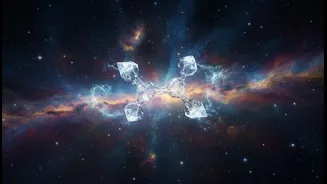
In the past few years, researchers have identified an astonishing variety of organic, or carbon-based, molecules floating in the interstellar medium near the galactic center. Recent studies have confirmed the presence of polycyclic aromatic hydrocarbons (PAHs), which are complex molecules made of fused carbon rings. On Earth, they form from the incomplete combustion of things like wood or fuel. In space, they are thought to be crucial players in the heating and cooling of the interstellar medium. More stunningly, in early 2026, JWST detected an unexpected abundance of small hydrocarbons like benzene, methane, and the highly reactive methyl radical in a nearby galaxy, suggesting this rich chemistry isn't unique to the Milky Way. These findings indicate that the chemical processes in galactic nuclei are far more active than models had predicted.
Finding Sugar in the Stars
Perhaps the most exciting recent discovery came in mid-2026, when scientists detected a true sugar molecule in a molecular cloud near the Milky Way's center for the first time. The sugar, called erythrulose, is a four-carbon molecule also found in raspberries. While sugars had previously been found in meteorites, finding one freely floating in the space between stars is a major milestone. It strengthens the theory that the building blocks of life don't necessarily need to form on a planet's surface. Instead, they could form in interstellar space, get incorporated into asteroids and comets, and then be delivered to young, forming planets like a cosmic care package, potentially seeding them for life.
Rewriting the Chemical Rulebook
The discovery of erythrulose was particularly surprising because it challenges existing theories of astrochemistry. Scientists had long assumed that complex molecules in space form by adding one carbon atom at a time. However, researchers found an abundance of the four-carbon erythrulose, but very little of the simpler three-carbon sugars they were initially looking for. This suggests that more complex pathways might be at play, such as two-carbon molecules combining on the icy surfaces of dust grains to form larger structures. This finding opens up new possibilities for how the essential ingredients for life can assemble in the cosmos.
Clues to Our Own Origin
Each of these molecular discoveries provides another piece of the grand puzzle of our cosmic origins. By studying the types, quantities, and locations of these molecules, scientists can trace the journey of essential elements like carbon across a galaxy's life cycle. They can learn how these elements are forged in stars, ejected into space, and then reassembled into new and more complex structures within molecular clouds. These clouds are the birthplaces of new stars and planetary systems. Understanding their chemical inventory is fundamental to understanding not just how planets form, but what they are made of. Ultimately, this research connects the vast, seemingly empty space between stars to the intricate biology on our own planet, suggesting the story of life on Earth may have begun long before our world even existed.