


Measure for Both Realities
Before falling for a specific style, measure your space meticulously. You need to plan for two different room layouts: one for daily life and one for entertaining. Start by defining the table's 'closed' footprint. It should feel right for your everyday
routine, allowing people to move around it comfortably without creating an obstacle. Use painter's tape to mark the dimensions on your floor. Then, do the same for the fully extended size. Remember to account for at least 90 cm of 'pull-back' space around the table for chairs. A table that is perfect when closed but makes the room unusable when open has not solved the problem.
Understand the Mechanism
The way a table extends impacts its ease of use and storage needs. Common mechanisms include butterfly leaves, drop-in leaves, and drop-leaf sides. A butterfly leaf is a self-storing extension that folds and tucks away neatly under the tabletop, which is highly convenient. Other tables use removable 'drop-in' leaves, which are inserted into the center. These are traditional but require you to have a separate place to store the leaves when not in use. Drop-leaf tables have hinged sides that collapse downwards, making them extremely space-efficient for very small kitchens or apartments. Consider how often you'll be extending the table and if you can do it alone. Modern tables with synchronised runners allow one person to open both sides smoothly at once.
Choose a Space-Saving Shape
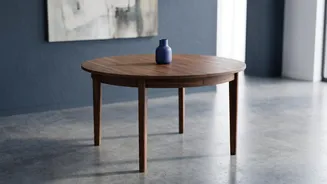
The shape of your table affects traffic flow and seating capacity. Rectangular tables are a natural fit for long, narrow rooms, following the direction of the space. Round tables, on the other hand, can feel more sociable and often work better in smaller or square-shaped rooms because they have no sharp corners to bump into. For compact homes, a round table with a pedestal base can be particularly effective, as it eliminates corner legs and allows you to tuck chairs in more freely. Many round tables extend into an oval shape, giving you the best of both worlds: a soft everyday footprint and a longer surface for hosting.
Material Matters for Durability
Your dining table is a high-traffic surface, so its material should match your lifestyle. Solid hardwoods like oak and walnut are timeless, durable, and can be refinished if they get scratched. They develop character over time and offer a warm, natural look. For busy households with children, engineered materials like sintered stone or ceramic are exceptionally tough, resisting scratches, stains, and heat. Glass tabletops can make a small space feel lighter and more open, but they are more susceptible to chips and show fingerprints easily. Be honest about how much maintenance you're willing to do before you commit to a material.
Factor In Seating and Stability
The number of people a table can seat depends on more than just its length. The position of the legs plays a huge role. A pedestal or trestle base often provides more flexibility for squeezing in an extra chair than four legs at the corners. When shopping, pay attention to the table's stability, especially when it is fully extended. A well-built table should feel just as sturdy when open as it does when closed. Heavier tables made from solid wood tend to be more stable than lighter alternatives. If you can't test it in a store, look for online reviews that comment on its stability during use.