





It All Begins with a Tilt
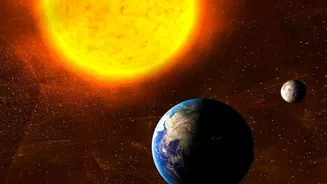
The primary reason for seasons and changing daylight hours has nothing to do with Earth's distance from the sun. Instead, it's all about our planet's axial tilt. Earth is tilted on its axis by about 23.5 degrees. This tilt remains constant as our planet makes
its year-long journey around the sun. Think of it like a spinning top that's permanently leaning to one side. This simple fact means that for half the year, the Northern Hemisphere is angled more towards the sun, giving us the direct rays and longer days of summer. For the other half, it's tilted away, leading to the shorter days and indirect sunlight of winter.
The Equinox: A Moment of Global Balance
The autumnal equinox, which occurs around September 22nd or 23rd, is a specific moment in Earth's orbit. On this day, the planet's tilt is neither toward nor away from the sun; it's perfectly sideways. As a result, the sun's most direct rays shine on the equator. The word "equinox" comes from Latin for "equal night," because on this day, every place on Earth experiences roughly 12 hours of daylight and 12 hours of darkness. It marks the astronomical start of autumn in the Northern Hemisphere and spring in the Southern Hemisphere. It’s a point of perfect, but fleeting, balance before a major shift.
The Great Shift: Tilting Away from the Sun
The moment the equinox passes, the balance is broken. The Northern Hemisphere continues along its orbital path, but now its tilt starts to angle it progressively away from the sun. Conversely, the Southern Hemisphere begins its tilt towards the sun. With our half of the world receiving less direct sunlight, the sun’s arc across the sky becomes lower and shorter each day. This translates directly into later sunrises and earlier sunsets, a process that continues day by day. This gradual turning away from the sun’s most intense energy is what causes the days to shorten and the temperatures to cool, leading us into winter. The process culminates at the winter solstice, the shortest day of the year, after which the Northern Hemisphere begins its slow tilt back toward the sun.
Why the Change Feels So Fast
If you've ever felt that daylight loss accelerates in September and October, you're not imagining it. The rate of change in daylight is not constant throughout the year. It’s slowest around the solstices (the longest and shortest days of the year) and fastest around the equinoxes. Think of it like a pendulum or a swing: it slows down and almost seems to hang motionless at its highest points before rapidly accelerating through the bottom of its arc. The equinox is the bottom of that arc. Around this time, we can lose several minutes of daylight every single day, making the transition feel abrupt.
A Curious Wrinkle: Equinox vs. Equilux
While the word "equinox" means "equal night," the day of the equinox isn't usually the day with exactly 12 hours of light and 12 hours of dark. That day is called the "equilux," and it typically occurs a few days after the autumnal equinox. This discrepancy is caused by two factors: how we define sunrise and the effect of Earth's atmosphere. Sunrise is defined as the moment the sun's upper edge appears over the horizon, not its center. Furthermore, our atmosphere refracts or bends sunlight, making the sun appear on the horizon when it's technically still below it. These two effects add several extra minutes of daylight to the equinox, meaning we have to wait a few more days for the day and night to be truly equal in length.