






Why 20 Minutes is a Game-Changer
Between classes, assignments, and a tight budget, a gym membership is often out of the question for students. The good news is, you don't need it. High-intensity circuit training, where you perform a series of exercises with minimal rest, is incredibly
efficient. Research shows that even short, intense workouts can significantly boost cardiovascular health, build muscle, and improve mental clarity. For a student, this means more than just physical fitness; it translates to reduced stress, better focus in lectures, and more energy to handle late-night study sessions. Twenty minutes is the perfect amount of time to challenge your body without eating into your valuable schedule.
The Golden Rules of Hostel Fitness
To make this work, you need a simple plan. First, consistency is key. Aim for three to four 20-minute sessions per week, ideally on non-consecutive days to allow your muscles to recover. Second, always warm up. Spend 2-3 minutes marching on the spot, doing arm circles, and performing slow bodyweight squats to prepare your body for exercise. Third, focus on form over speed. It's better to do 10 perfect squats than 20 sloppy ones. Finally, listen to your body. If something hurts, stop. You can modify exercises to make them easier or harder.
Your 20-Minute Full-Body Circuit
This workout is designed as a circuit. You will perform each of the five exercises below for 45 seconds, followed by 15 seconds of rest before moving to the next one. Once you complete all five exercises, that’s one round. Rest for 60 seconds, then repeat the entire circuit three more times for a total of four rounds. This structure keeps your heart rate up and works all major muscle groups efficiently within 20 minutes. All you need is a small patch of floor space.
Exercise 1: Bodyweight Squats
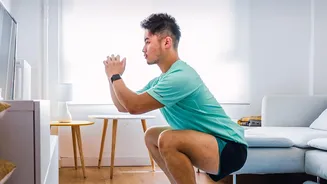
This is the foundation for lower body strength. Stand with your feet shoulder-width apart, chest up, and core engaged. Lower your hips back and down as if you're sitting in a chair. Keep your back straight and ensure your knees track over your feet, not past your toes. Go as low as you can comfortably, then push through your heels to return to the starting position. Squats work your quads, hamstrings, and glutes, building powerful legs.
Exercise 2: Push-Ups
The ultimate upper-body exercise, push-ups target your chest, shoulders, and triceps while also engaging your core. Start in a high plank position with your hands slightly wider than your shoulders. Lower your body until your chest nearly touches the floor, keeping your back flat. Push back up to the start. If this is too challenging, perform the push-ups on your knees. This modification still provides excellent benefits while you build strength.
Exercise 3: Alternating Lunges
Lunges are fantastic for balance, stability, and working each leg independently. From a standing position, step one foot forward and lower your hips until both knees are bent at a 90-degree angle. Your front knee should be directly above your ankle, and your back knee should hover just above the ground. Push off your front foot to return to the start, then repeat with the other leg. Alternate legs for the duration of the interval.
Exercise 4: The Plank
A strong core is essential for almost every movement. The plank is a simple but intense way to build it. Place your forearms on the floor with your elbows directly under your shoulders. Extend your legs back, resting on your toes. Your body should form a straight line from your head to your heels. Brace your core and glutes, and avoid letting your hips sag. Hold this position for the full 45 seconds.
Exercise 5: Burpees
The burpee is a full-body powerhouse that skyrockets your heart rate. From standing, drop into a squat, place your hands on the floor, and kick your feet back into a plank. Immediately jump your feet back towards your hands, then explode up into a jump with your arms overhead. For a lower-impact version, you can step your feet back and forward instead of jumping and omit the final jump. This exercise combines strength and cardio in one move.
Making It A Habit
The hardest part of any routine is sticking with it. Schedule your workouts like you would a class. Find a workout buddy in your hostel to keep each other motivated. Track your progress—maybe you can do more push-ups after two weeks, or hold the plank for longer. Celebrating these small wins makes a huge difference. Remember, fitness isn't about finding time; it's about making time. Twenty minutes a day is a small investment for a healthier, more focused, and more energetic you.