





The First Threat: A Brutal Vacuum
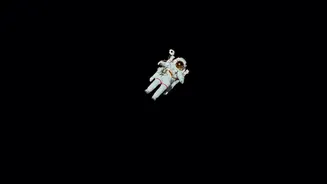
The most immediate danger in space is the near-perfect vacuum. Here on Earth, the air around us exerts a constant pressure on our bodies, which our internal systems are perfectly adapted to. Without that external pressure, things go horribly wrong. In
seconds, an unprotected person would lose consciousness from a lack of oxygen, a condition called anoxia. But a far stranger and more gruesome process also begins: ebullism. This is where the reduced pressure causes the boiling point of liquids to drop. At the normal human body temperature of 37°C, the water in your tissues would begin to 'boil' and turn to gas, causing the body to swell dramatically. While you wouldn't explode like in a sci-fi movie, this process would be fatal within minutes.
The Solution: A Personal Atmosphere
A spacesuit’s primary job is to create a pressurised, Earth-like environment. This is achieved with a 'bladder layer', which is essentially a human-shaped, airtight balloon made of a material like urethane-coated nylon. This layer is inflated with pure oxygen to a pressure of around 4.3 pounds per square inch (psi). While much lower than Earth’s 14.7 psi atmospheric pressure, it’s enough to prevent ebullism and keep all bodily fluids in their liquid state. A snug restraint layer is fitted over the bladder to stop it from ballooning outwards into a rigid, immovable shape, ensuring the astronaut can still bend their arms and legs.
Providing Breathable Air
Of course, pressure alone isn't enough; an astronaut needs to breathe. This is the job of the Portable Life Support System (PLSS), the iconic backpack unit. The PLSS supplies pure oxygen to the helmet for breathing and circulates it through the suit. Just as important, it removes the carbon dioxide (CO2) that the astronaut exhales. Early Apollo suits used lithium hydroxide canisters to scrub CO2, while modern suits on the International Space Station (ISS) use systems that can be regenerated and reused. A fan circulates the air, and a special system also removes excess humidity from the astronaut's breath and sweat.
Surviving Extreme Temperatures
Space temperatures are a violent see-saw. In direct sunlight, a suit’s surface can rocket to 121°C, while in shadow it can plummet to a frigid -157°C. To manage this, astronauts wear a Liquid Cooling and Ventilation Garment (LCVG) as their base layer. This is essentially a set of long underwear woven with a network of fine plastic tubes containing circulating cool water. This water absorbs the astronaut's body heat and carries it to the PLSS, where a device called a sublimator exposes some of the water to the vacuum of space. The water instantly freezes and then turns to vapour, carrying the excess heat away.
A Shield Against Space Itself
Beyond pressure and temperature, a spacesuit must act as a shield. The outermost layers are known as the Thermal Micrometeoroid Garment. This section is made of multiple layers of advanced materials. Seven layers of aluminised Mylar, working like the insulation in a thermos flask, help stabilise the astronaut's temperature against the extremes of space. The final, outermost layer is a tough, triple-fabric weave that includes materials like Kevlar, the same fabric used in bulletproof vests. This provides crucial protection against impacts from micrometeoroids—tiny particles of rock and debris travelling at incredible speeds—and also shields the astronaut from harmful solar radiation.