


Defining the Cosmic Threat
Before we can find them, we need to know what we're looking for. Astronomers focus on Near-Earth Objects (NEOs), which are comets and asteroids whose orbits bring them within 30 million miles of Earth's path around the Sun. Within this group is a more
specific category: Potentially Hazardous Asteroids (PHAs). These are the objects that warrant the closest attention. A PHA is defined by two key criteria: its size and its proximity to Earth. To be classified as potentially hazardous, an asteroid must be larger than about 140 meters (roughly 460 feet) in diameter and its orbit must bring it within 4.65 million miles of our planet's orbit. This size is large enough to cause significant regional damage upon impact, and the distance is close enough in cosmic terms to be worth monitoring closely.
A Global Network of Eyes
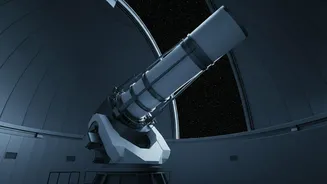
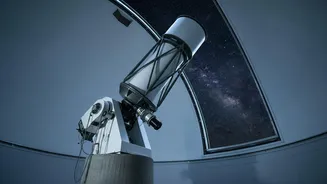
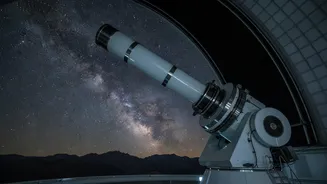
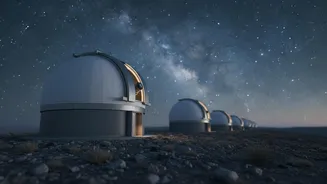
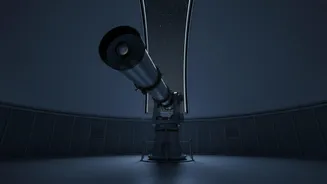
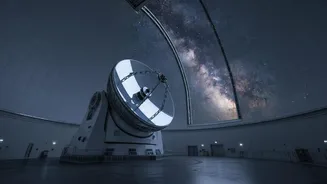
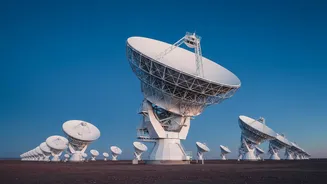
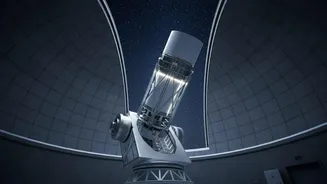
No single telescope can watch the entire sky at once. That's why asteroid detection relies on a coordinated network of observatories around the world. In the United States, NASA's Planetary Defense Coordination Office (PDCO) funds and coordinates many of these search programs. Three of the most prolific surveys are the Catalina Sky Survey (CSS) in Arizona, the Panoramic Survey Telescope and Rapid Response System (Pan-STARRS) in Hawaii, and the Asteroid Terrestrial-impact Last Alert System (ATLAS), which has telescopes in Hawaii, Chile, and South Africa. Together, these surveys systematically scan the night sky, with projects like CSS and Pan-STARRS being credited with discovering the vast majority of all known NEOs. This international collaboration ensures that we have continuous coverage of the skies.
The Search in Action
The basic method for finding an asteroid is elegantly simple: look for things that move. Survey telescopes take a series of images of the same patch of sky, separated by several minutes. Computers then compare these images, searching for any dot of light that has shifted its position against the fixed backdrop of distant stars and galaxies. An automated system flags these moving objects as potential asteroid candidates. For example, the ATLAS system takes four 30-second exposures of a sky patch over a short period, and its software analyzes them for movers. Once a candidate is identified, its details are sent to the Minor Planet Center (MPC), a global clearinghouse for such observations, which helps coordinate follow-up.
From Detection to Orbit
Finding a dot of light is just the first step. To determine if it's a threat, scientists must calculate its orbit, a process known as orbit determination. After a new object is reported, telescopes around the world—including those operated by professional and amateur astronomers—will take additional observations to track its movement. Each new observation of the asteroid's position over time allows scientists to refine their calculations of its trajectory through space. Organizations like the Center for Near-Earth Object Studies (CNEOS) at NASA's Jet Propulsion Laboratory use this data to project the asteroid's path for the next 100 years, continually updating its risk assessment as more information comes in. More than 99% of known PHAs pose no impact threat in the next century.
The Next Generation of Asteroid Hunters
While ground-based telescopes are powerful, they have limitations. They can't see asteroids that approach from the direction of the Sun, and very dark asteroids are hard to spot. To address this, NASA is developing the NEO Surveyor, a space-based infrared telescope scheduled for launch no earlier than September 2027. Operating from a point between the Earth and the Sun, NEO Surveyor will be able to detect asteroids by sensing their heat, which they radiate after being warmed by sunlight. This allows it to spot objects regardless of how dark their surface is and to find those that are obscured by the Sun's glare. The mission aims to drastically accelerate the discovery of the remaining undiscovered NEO population, helping to find 90% of objects 140 meters and larger within ten years of operation.