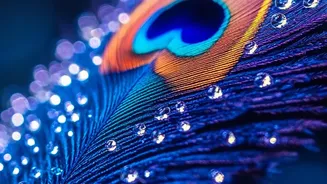




The peacock, India’s national bird, is a symbol of grace and beauty, largely thanks to its stunning tail. But those vibrant blues, greens, and golds aren't what they seem. The secret to their shimmer lies not in pigments, but in physics.
Not Pigment, But Physics
When we see colour
in the natural world, we usually think of pigments—chemical substances that absorb certain wavelengths of light and reflect others. A leaf is green because chlorophyll pigment absorbs red and blue light. But a peacock’s feather is different. If you were to grind it up, you would be left with a dull, brownish powder. This is because the feathers are primarily pigmented with melanin, which is brown or black. The dazzling array of colours we admire is not chemical, but structural. This phenomenon is known as structural colouration, and it’s a trick of the light performed by nature’s own nanotechnology.
A Masterpiece of Micro-Engineering
The magic happens within the feather's smallest components, called barbules. Under an electron microscope, these barbules reveal an incredibly ordered, lattice-like structure. They are made of keratin—the same protein in our hair and nails—and contain arrays of tiny, rod-like structures called melanosomes. These rods are arranged in a precise, repeating 2D pattern, like a natural photonic crystal. It is this microscopic architecture that interacts with light to create the colours we see. The size of the melanosomes and the spacing between them are precisely controlled to produce different hues.
The Science of Shimmer
This structural colouration works through a process called thin-film interference. It's the same effect that creates the rainbow shimmer on a soap bubble or a thin film of oil on water. When light strikes the feather's surface, some of it reflects off the top layer of keratin, while some of it passes through and reflects off the lower layers of melanin rods. These reflected light waves then interfere with each other. Depending on the spacing of the layers, certain wavelengths (colours) of light are cancelled out (destructive interference), while others are amplified and reinforced (constructive interference). The colour that gets amplified is the one we see. Because the perceived colour depends on the angle at which you view it, the feathers display iridescence, shimmering and changing hue as the bird moves.
The Evolutionary Advantage
This elaborate and beautiful display serves a critical evolutionary purpose: attracting a mate. The term 'peacock' refers to the male, while the female is a 'peahen'. It is the male who possesses the spectacular train, which can consist of over 200 feathers. Peahens tend to choose males with the largest, brightest, and most intricate feather displays. This breathtaking tail is a form of 'honest signalling'; a vibrant and well-maintained train suggests the male is healthy and has good genes, making him a desirable partner. The very existence of such a burdensome yet beautiful feature, which once vexed Charles Darwin, is a classic example of sexual selection at work. In contrast, peahens are a drab brown and grey, allowing them to camouflage themselves while nesting and caring for their young.
From Feathers to Future Tech
The peacock's mastery of structural colour is not just a point of natural wonder; it's a source of inspiration for human innovation. This field, known as biomimicry, looks to nature to solve complex engineering problems. Scientists are studying the structure of peacock feathers to develop new technologies, from more vibrant, pigment-free paints and textiles to advanced optical devices and anti-counterfeiting materials. By mimicking the feather's photonic crystals, researchers have created sensors that change colour in response to temperature or pressure, which could be used in food packaging to indicate spoilage or in healthcare for monitoring. The same principles could lead to more efficient solar arrays or even adaptive camouflage.