

How do you find something that is completely invisible? Astronomers face this cosmic challenge daily, hunting for black holes. A new initiative is now using a clever trick: looking for the gravitational clues they leave in the light of distant stars.
The Galaxy's Invisible Ghosts
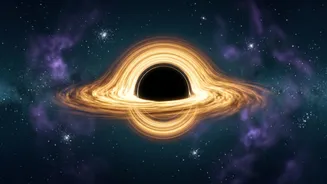
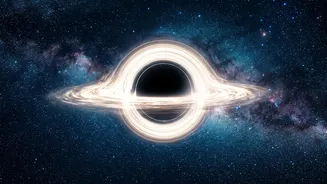
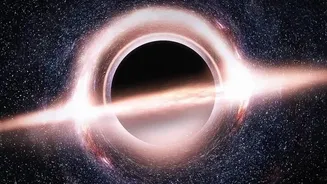
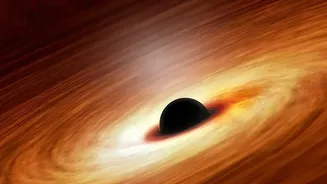
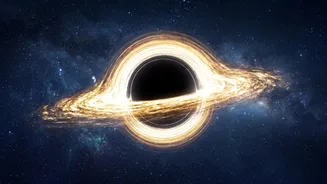
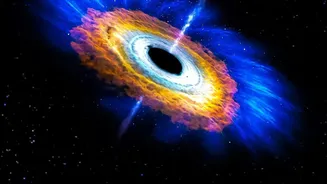
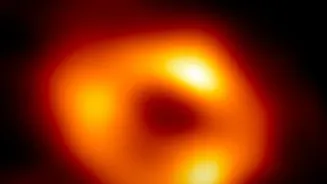
Our Milky Way galaxy is haunted. Scientists estimate it’s home to as many as 100 million stellar-mass black holes, the collapsed remnants of giant stars. Yet, we have only officially catalogued around 70. The reason for this discrepancy is simple: most black holes are 'rogue' or isolated, drifting silently through space without a companion star to feast on. Traditional detection methods often rely on seeing the X-rays produced when a black hole pulls material from a nearby star. But a lone black hole is dark, quiet, and utterly invisible against the black backdrop of space, making it a ghost in the cosmic graveyard. Finding them has been one of the great challenges in modern astronomy, leaving a huge gap in our understanding of how massive stars live and die. To find these missing millions, astronomers needed a new way to see the unseen.
A Trick of the Light
The solution comes from a concept first predicted by Albert Einstein: gravity bends light. This phenomenon, known as gravitational lensing, means that a massive object can act like a cosmic magnifying glass. When a dense object, like a black hole, passes directly between us and a distant star, its intense gravity warps spacetime and bends the star’s light rays. From our vantage point on Earth, this has a curious effect: the background star appears to temporarily brighten and then fade back to normal as the black hole drifts past. This specific type of gravitational lensing, called microlensing, doesn't depend on the lensing object emitting any light of its own, making it the perfect tool for finding isolated black holes. The duration and character of the brightening can even help scientists estimate the mass of the invisible object, confirming if they've found one of their elusive quarries.
The Hunt Is On
This is where the 'Black Hole Hunters' initiative comes in. It is a citizen science project launched by astronomers, including those from the University of Southampton, that empowers the public to join the search. The project sifts through vast amounts of data collected by missions like NASA's Transiting Exoplanet Survey Satellite (TESS). TESS monitors millions of stars, recording their brightness over time. Advanced AI algorithms first scan this data for any unusual brightening events that might signal a microlensing event. However, AI can be confused by other stellar phenomena, like starspots or natural pulsations. This is where human eyes become crucial. The project presents these potential black hole signatures to volunteers as simple graphs, asking them to help identify the unique, smooth brightening pattern characteristic of a microlensing event. No advanced degree is needed, just a keen eye for patterns.
Mapping the Unseen Universe
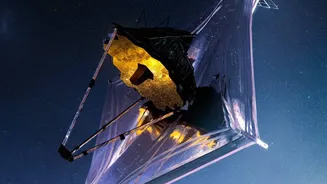
Every candidate identified by a volunteer helps professional astronomers narrow their focus. Promising signals can be flagged for followup observations with powerful telescopes, like the Vera C. Rubin Observatory in Chile or even the James Webb Space Telescope. These observations can provide the precise measurements needed to confirm the presence of a black hole and measure its mass. The 'Black Hole Hunters' initiative is more than just a cosmic treasure hunt. By finding these isolated black holes, scientists can build a comprehensive map of the Milky Way's unseen architecture. Each discovery provides vital data that helps refine our models of stellar evolution, galaxy formation, and even the distribution of dark matter. It’s a powerful example of how the collaborative effort of scientists and engaged citizens can illuminate the darkest corners of our universe, one flicker of starlight at a time.