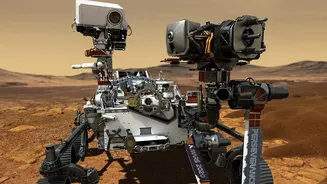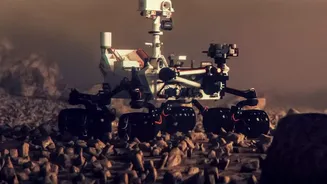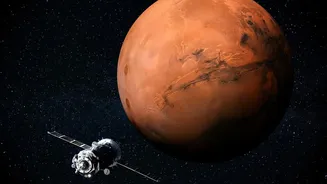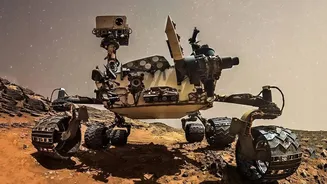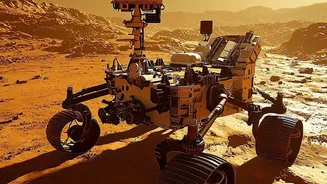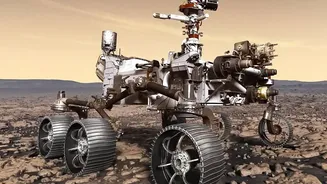





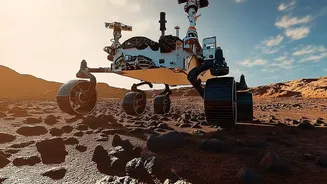
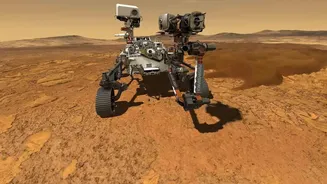

For years, NASA's Perseverance rover has been drilling and storing precious rock samples on Mars, a treasure trove that could answer whether life ever existed on the Red Planet. Now, the agency is launching a fresh effort to bring them home.
The Most Ambitious Delivery Ever
Bringing pieces
of another planet back to Earth is one of the most complex robotic missions ever conceived. The Mars Sample Return (MSR) campaign, a joint effort with the European Space Agency (ESA), involves multiple spacecraft, a launch from the Martian surface, and a rendezvous in deep space. Since its landing in 2021, the Perseverance rover has been dutifully collecting and caching core samples in titanium tubes, creating humanity's first 'pantry' on another world. Some tubes are stored inside the rover, while others have been carefully placed in a backup depot on the surface, ready for a future pickup. The goal is to get these samples into the hands of scientists in state-of-the-art labs on Earth, where they can be analysed with equipment far too advanced to ever send to Mars.
A Mission in Need of a Blueprint
While the goal is clear, the 'how' has been a moving target. The MSR program has faced significant challenges, including ballooning cost estimates, which once soared to $11 billion with a return date as late as 2040. Such figures and timelines were deemed unacceptable by NASA, prompting reviews and a search for a more efficient and timely architecture. To that end, NASA has announced a new initiative called the Perseverance Sample Retrieval Architecture, or PSRA. Unveiled in early November 2026, this effort is designed to produce a final, workable plan for this historic retrieval. The PSRA team will kick off its work in January 2027, tasked with assessing all options and delivering a final report by the winter of 2027-2028.
Meet the New Plan: PSRA
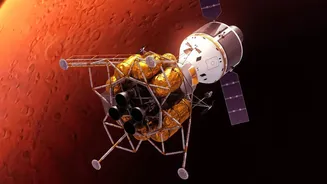
While the PSRA team will formalize the final strategy, its work builds on a revised mission concept that is simpler and more robust than initial designs. The original plan involved sending a second 'fetch rover' to collect the samples. However, given Perseverance's excellent performance and expected longevity, the primary plan now relies on Perseverance itself to drive the samples to the Sample Retrieval Lander (SRL). The SRL will be a marvel of engineering, carrying the Mars Ascent Vehicle (MAV)—the first rocket ever to launch from another planet—and an ESA-built robotic arm to transfer the samples. This eliminates the need for a whole separate rover and lander, streamlining the mission.
A High-Flying Backup Plan
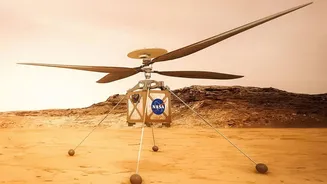
But what if Perseverance, after years of service, is unable to complete the delivery? That's where the backup plan comes in, inspired by the wild success of the Ingenuity helicopter. Instead of a fetch rover, the SRL will carry a pair of advanced Sample Recovery Helicopters. These rotorcraft are not just copies of Ingenuity; they will be equipped with small wheels to drive short distances on the ground and a robotic grabber to pick up sample tubes. If needed, these helicopters would fly out to the sample depot, grab the tubes one by one, and ferry them back to the lander. This dual_threat approach—relying on the proven rover with a high_tech aerial backup—gives the mission a much stronger chance of success.
The Race to Bring Mars Home
With the PSRA initiative now in motion, NASA aims to lock in the budget and timeline for this critical mission. The renewed push comes as other nations also set their sights on Mars. China's Tianwen_3 mission, for example, is reportedly on track to launch around 2028 with the goal of returning its own samples by 2031. This adds a sense of urgency to NASA's efforts. The current architecture envisions the Earth Return Orbiter launching in 2027, followed by the Sample Retrieval Lander in 2028, with the precious cargo of Martian rocks and soil splashing down on Earth in 2033. The findings could change our understanding of the solar system forever.