





A Telescope of Two Continents
The Square Kilometre Array isn't just one telescope; it's a planet-spanning scientific instrument. It consists of two separate but coordinated sites: SKA-Low in Australia, which uses hundreds of thousands of Christmas-tree-like antennas, and SKA-Mid in South
Africa, which employs hundreds of large, sensitive dishes. This global collaboration, with its headquarters in the UK, aims to build the world's largest radio telescope, giving us a view of the cosmos fifty times more sensitive than any previous instrument. The sheer scale of the project involves more than a dozen countries, including a significant contribution from India, pooling resources to answer some of the biggest questions in science.
Listening, Not Just Looking
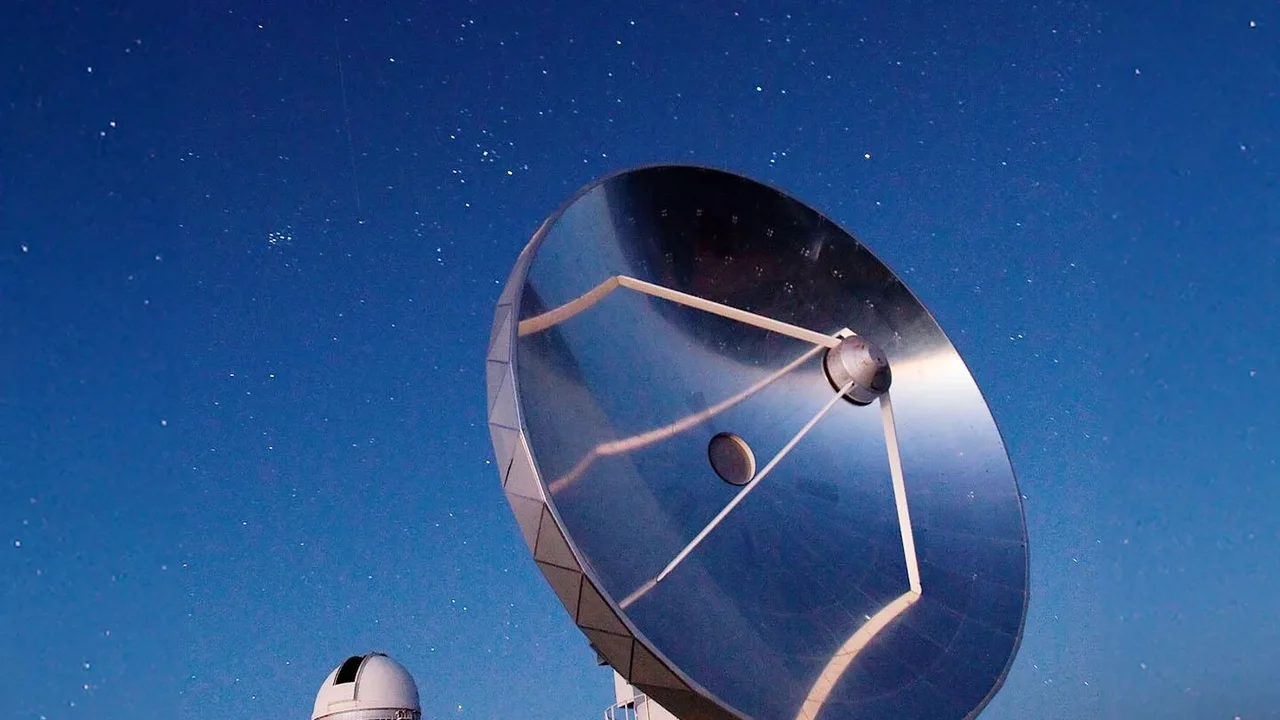
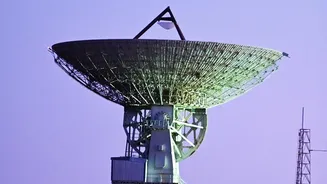
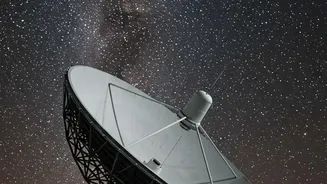
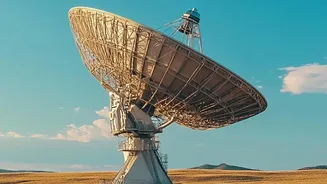
When we think of a telescope, we usually picture looking through a lens at stars and planets. But optical telescopes only see a tiny fraction of what the universe has to offer. Radio telescopes work differently. Instead of visible light, they collect radio waves—invisible energy emitted by everything from newborn stars to colliding black holes. These waves can travel through the vast cosmic clouds of dust and gas that block visible light. The SKA’s dishes in South Africa act like giant ears, cupped to catch these incredibly faint cosmic signals. Each 15-metre dish is a precision-engineered collector, designed to gather radio waves and focus them onto a highly advanced receiver.
Signals from the Dawn of Time
So, what exactly is the SKA listening for? Its primary mission is to peer back to a mysterious era known as the 'Cosmic Dawn' and the subsequent 'Epoch of Reionization'. This period, which occurred in the first billion years after the Big Bang, is when the very first stars and galaxies began to form, lighting up the universe for the first time. Before these first stars ignited, the cosmos was filled with a vast fog of neutral hydrogen gas. This hydrogen emitted a faint radio signal at a characteristic wavelength of 21 centimetres. As the universe expanded over billions of years, this signal has been stretched and weakened, making it incredibly difficult to detect. Capturing these whispers is the key to understanding how the first cosmic structures were born.
The Power of Many
A single dish, no matter how big, could never detect these faint signals alone. The SKA’s power comes from a technique called interferometry. The signals from all 197 dishes of the SKA-Mid telescope are combined digitally. By linking the dishes, spread over distances of more than 100 kilometres, they function as a single, gigantic virtual telescope. This not only dramatically increases the sensitivity, allowing it to detect signals a human-made airport radar would produce from 50 light-years away, but also provides incredible resolution—the ability to see the sky in sharp, fine detail. The raw data from the dishes is streamed via fibre optic cables to a powerful supercomputer, which performs the complex calculations needed to turn the collected signals into a coherent image of the distant universe.
India’s Role as the Telescope’s Brain
India is not just a participant but a pivotal leader in this global endeavour. Having been involved since the project's inception, India formally joined the SKA Observatory with a commitment of ₹1,250 crore. A consortium of over 20 Indian institutions, coordinated by the National Centre for Radio Astrophysics (NCRA) in Pune, is making crucial contributions. Most notably, Indian scientists and engineers led the design and are now overseeing the development of the Telescope Manager—the complex software that will act as the entire observatory’s 'brain' and 'nervous system'. This sophisticated system will control the telescopes, execute astronomical observations, and monitor the vast flow of data, placing Indian expertise at the very heart of the SKA's operations.