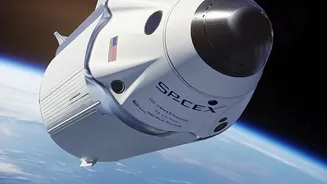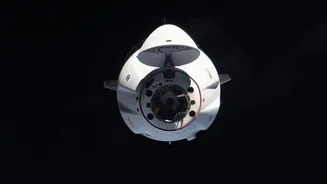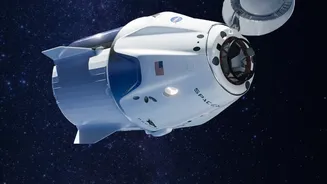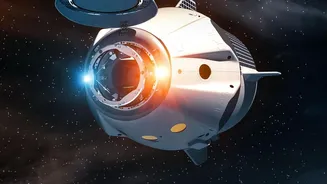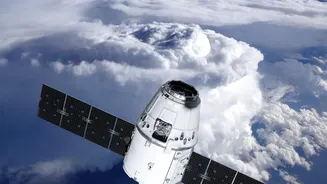


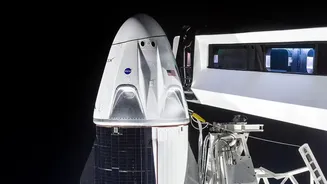
Another critical space delivery is complete. NASA has confirmed the successful end of the 35th Commercial Resupply Services mission by SpaceX, which concluded with the splashdown of the Dragon capsule, returning vital science to Earth.
A Perfect Landing
The SpaceX Dragon
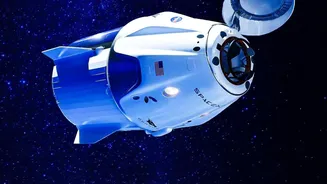
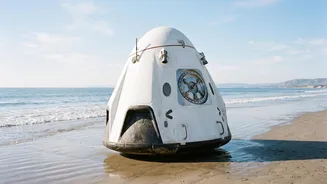
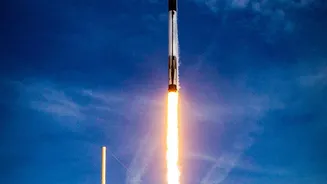
spacecraft successfully undocked from the International Space Station (ISS) on November 20 and began its journey home. After a fiery re-entry through Earth's atmosphere, it splashed down safely in the Pacific Ocean off the coast of California on November 21. Recovery teams were immediately on site to retrieve the capsule, which carried thousands of pounds of valuable cargo. The mission, which began with a launch from Florida on October 13, lasted just over a month and marks another successful chapter in the ongoing partnership between NASA and commercial space companies.
More Than Just a Delivery
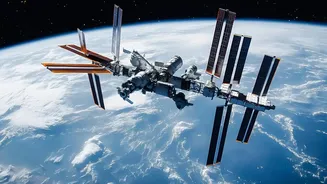
The primary goal of the CRS-35 mission was to deliver essential supplies to the astronauts living and working on the ISS. The Dragon capsule carried over 6,300 pounds of cargo on its trip up, including crew supplies, food, and crucial hardware for the orbiting laboratory. A key piece of hardware on this mission was the final set of iROSA (International Space Station Roll-Out Solar Arrays). These arrays have been progressively installed to upgrade the station's power grid, boosting its energy generation capacity by as much as 30 percent and ensuring it can support future scientific endeavors.
Groundbreaking Science in Zero Gravity
Beyond logistics, the CRS-35 mission was a platform for groundbreaking scientific research. A significant portion of the payload was dedicated to experiments designed to study the effects of microgravity on human health and biology. One major investigation involved sending small, lab-grown models of the human brain to the station to study how spaceflight affects the brain at a cellular level. Another experiment looked at producing artificial retinal tissue, which could lead to treatments for retinal diseases on Earth. Researchers also sent up experiments to study cardiovascular health, with Mount Sinai Health System launching bioengineered heart and brain tissue to model the aging process in space.
The Precious Return Cargo
The return trip is arguably as important as the delivery. The Dragon is currently the only cargo vehicle capable of bringing research samples back to Earth intact, as other resupply ships burn up on re-entry. This mission returned thousands of pounds of finished experiments and biological samples that require immediate analysis in labs on the ground. Among the return cargo were frozen tumor organoids that had been treated in space, which could help scientists develop new cancer treatments. The capsule also brought back a 3D-bioprinted blood vessel structure used to study cardiovascular aging, and microbial samples to understand how antibiotic-resistant bacteria behave in space. These samples are invaluable, providing insights that are impossible to gain on Earth.
The Power of Commercial Partnership
The CRS-35 mission highlights the strength and reliability of NASA's commercial resupply model. By partnering with private companies like SpaceX, NASA has created a dependable and cost-effective pipeline to the International Space Station. This approach has not only sustained the operations of the ISS for over a decade but has also fostered a robust commercial space economy in low-Earth orbit. Thirty-five missions in, the regular cadence of launches, dockings, and returns has become a cornerstone of modern space exploration, allowing NASA to focus on deep-space missions to the Moon and Mars while the private sector innovates closer to home.