



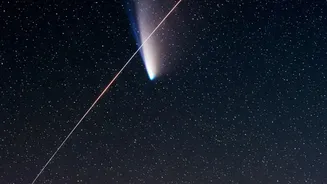
This October, the night sky offers a special treat: a chance to see tiny pieces of the most famous comet in history. The Orionid meteor shower is coming, and its story connects us directly to the legendary Halley's Comet.
A Ghostly Trail of Cosmic Dust
Imagine a trail of glitter left
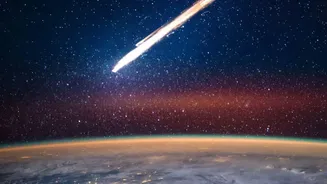
behind by a cosmic celebrity. That's essentially what a meteor shower is. As comets or asteroids orbit the Sun, they shed a stream of dust and rock. When Earth's own orbit around the Sun passes through one of these dense debris trails, those tiny particles slam into our atmosphere at incredible speeds. They burn up from the friction, creating the brilliant streaks of light we call meteors, or more popularly, 'shooting stars'. It’s not the stars that are falling, but rather ancient remnants of a celestial wanderer putting on a final, fiery show.
The Legendary Parent: Halley's Comet
The Orionids are the cosmic offspring of none other than 1P/Halley, or Halley's Comet. This is arguably the most famous comet in human history, known for its predictable return to our skies roughly every 76 years. It was Edmond Halley who, in 1705, realised that sightings from 1531, 1607, and 1682 were all of the same object, correctly predicting its return in 1758. The comet itself last visited our inner solar system in 1986 and isn't due back until 2061. But you don't have to wait that long to see a piece of it. Each October, Earth glides through the dusty path Halley has carved through space over thousands of years.
From Comet Debris to a Light Show
The process is a beautiful consequence of orbital mechanics. As Halley's Comet approaches the Sun, the intense solar radiation heats its icy nucleus. This causes ice to turn directly into gas, a process called sublimation, which violently ejects dust and rock particles that were trapped inside. This cloud of debris continues to travel along the comet's orbital path. So, even though the comet is currently far away in the outer solar system, its trail remains. The Orionid meteor shower happens when Earth passes through this stream of particles. Hitting our atmosphere at a blistering speed of about 66 kilometres per second, they vaporise in brilliant flashes of light.
How to Watch the Orionids in India
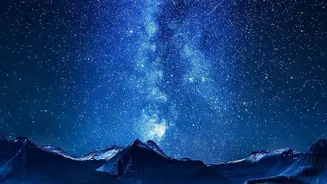
The Orionid meteor shower will be active from early October to early November, but the best time to watch in 2026 is during its peak on the night of October 21-22. For the best show, you’ll want to look up in the hours after midnight until just before dawn. Find a spot far away from city lights, as light pollution can wash out all but the brightest meteors. You don't need a telescope or binoculars. Just find a comfortable spot, perhaps with a blanket or a reclining chair, and lie back. Give your eyes about 20 to 30 minutes to fully adjust to the darkness. The meteors will appear to radiate from the constellation Orion, but they can streak across any part of the sky, so it's best to have a wide, open view.
A Fast and Furious Display
What makes the Orionids particularly special is their speed. Travelling at 66 km/s, they are among the fastest of all meteor showers. This high velocity means they can be exceptionally bright and often leave behind glowing 'trains'—incandescent trails of gas that can linger in the sky for several seconds after the meteor has vanished. On a good night, from a dark location, you might see between 15 and 20 meteors per hour. While the bright moon in 2026 might interfere with the show until it sets around 3 a.m., the hours just before dawn will provide a dark window for some prime viewing.
Halley's Other Gift: The Eta Aquariids
Halley's Comet is a two-for-one deal. Its orbit intersects with Earth's at two different points, creating two distinct meteor showers each year. In October, we get the Orionids. Six months later, in early May, Earth passes through another section of Halley’s debris trail, resulting in the Eta Aquariid meteor shower. So, when you’re watching the sky this October, remember that you’re witnessing one half of a celestial legacy left behind by a single, spectacular comet that has captivated humanity for millennia.