





What Exactly Is the Tachocline?
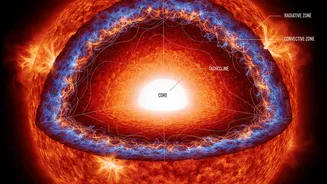
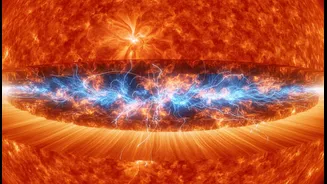
Imagine two parts of a giant machine spinning at different speeds. Where they meet, there's enormous friction and turbulence. The Sun has a similar meeting point deep inside, and it's call ed the tachocline. The inner part of the Sun, the radiative zone,
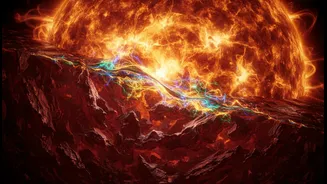
rotates as a solid, rigid body. But the outer layer, the convection zone, is a chaotic sea of hot gas that spins faster at its equator than at its poles. The tachocline is the incredibly thin boundary layer that separates these two distinct rotational styles. It lies about 200,000 kilometres below the solar surface. Despite its vast scale, the layer itself is remarkably thin, less than 5% of the Sun's radius, a puzzle that has long challenged scientific models.
The Engine Room of the Sun's Magnetism
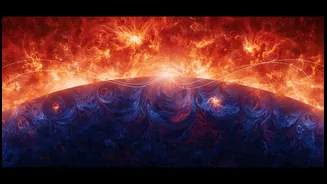
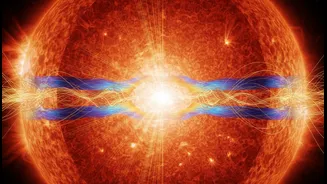
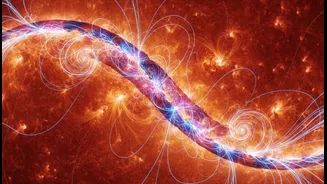
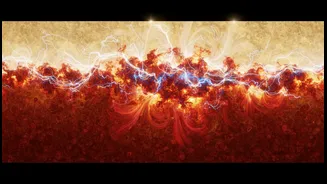
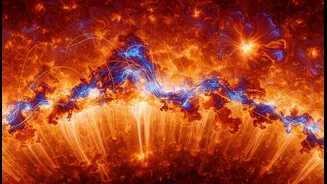
The reason scientists are so fascinated by the tachocline is that it's believed to be the heart of the solar dynamo—the process that generates the Sun's powerful and complex magnetic field. The immense shearing force in this layer, where fast-moving and slow-moving plasma grind against each other, is thought to stretch, twist, and amplify weak magnetic fields into immensely powerful ones. These amplified magnetic fields are then stored in the tachocline before they become buoyant and rise to the surface, where they burst through as sunspots. These sunspots are the trigger points for the violent solar activity that defines our star's weather.
New Clues from Advanced Simulations
For years, computer models struggled to explain why the tachocline remains so thin; they predicted it should thicken over time as the turbulent convection zone bleeds into the stable radiative zone. However, recent breakthroughs using state-of-the-art supercomputer simulations have provided a compelling answer. Research from a NASA-supported team has shown that a fluctuating magnetic field, generated by the dynamo process itself, is the key to keeping the tachocline confined. In essence, the magnetic field it helps create also acts as a container, pushing back against the turbulent motions and maintaining the layer's signature thinness. For the first time, models have spontaneously produced a stable, thin tachocline without being artificially forced to do so.
Why the Tachocline Matters on Earth
While this all sounds like distant celestial mechanics, the tachocline has a direct impact on our daily lives. The magnetic field it generates powers space weather—events like solar flares and coronal mass ejections (CMEs). When directed at Earth, these powerful blasts of particles and radiation can have serious consequences. They can disrupt satellite communications, damage GPS navigation systems, pose a radiation risk to astronauts and airline passengers on polar routes, and even overload power grids, causing widespread blackouts. By better understanding the engine that drives this activity, scientists hope to improve their ability to forecast severe space weather, giving us crucial time to prepare and protect our vital infrastructure.
A Window into Other Stars
Beyond protecting our technology, solving the mystery of the tachocline helps us understand not just our own Sun, but countless other stars across the galaxy. The processes happening in our Sun's interior are thought to be common in many sun-like stars. Understanding how stellar magnetic fields are born and evolve is fundamental to astrophysics. It can even provide clues in the search for life elsewhere. A star's magnetic activity determines the harshness of the space weather around it, which can either protect or strip away the atmospheres of orbiting planets. By decoding our Sun, we are learning what makes a star system potentially hospitable, or hostile, to life.