




Seeing the Invisible
The incredible images from telescopes like the NASA/ESA/CSA James Webb Space Telescope or the Hubble Space Telescope aren't photographs in the traditional sense. These powerful observatories are scientific instruments designed to detect light far beyond
the narrow band of visible light our eyes can perceive. They see the universe in infrared and ultraviolet wavelengths, which are invisible to us. Each image starts as a set of black-and-white data collected through different filters. These filters are designed to isolate specific wavelengths of light, each corresponding to different chemical elements, temperatures, or physical processes occurring in space.
Painting with Light and Data
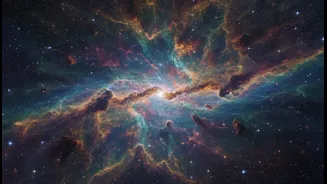
Image processors and scientists act as cosmic artists, translating this complex, invisible data into a full-colour image. They take the separate black-and-white images from each filter and assign a colour to each one—typically red, green, or blue. This technique is often called 'representative colour' or 'false colour' imaging. The colours are chosen deliberately and chromatically: the shortest wavelengths of light are assigned to bluer colours, and the longest wavelengths to redder ones. This allows us to see details that would otherwise be hidden. For example, assigning red to the glow of hydrogen gas and blue to oxygen can reveal the structure and composition of a nebula in stunning detail. This process turns raw data into a scientifically meaningful visualization.
Recent Masterpieces from the Cosmos
Recent releases from both NASA and ESA continue to push the boundaries of what we can see. To mark its fourth anniversary in July 2026, the James Webb Space Telescope released breathtaking new images of Centaurus A, a peculiar galaxy about 11 million light-years away. Webb’s infrared vision pierced through the galaxy’s thick dust lanes, which normally obscure our view, to reveal a dense field of individual stars and perplexing dust structures that will help scientists understand how galaxies evolve after cosmic collisions. Similarly, NASA's Hubble Space Telescope recently released a dazzling portrait of the globular cluster Messier 3, showcasing over 500,000 stars in brilliant red, white, and blue hues to mark the United States' 250th anniversary.
The Science Behind the Beauty
While the end result is undeniably beautiful, the primary purpose of this colourisation is scientific discovery. By assigning different colours to various elements and light wavelengths, astronomers can distinguish between different features within a single image. They can map out star-forming regions, trace the shockwaves from a supernova, or identify the distribution of dust and gas within a galaxy. In the recent Webb images of Centaurus A, the mid-infrared view highlights glowing dust, revealing where old stars are shedding material and new stars are being born. The combined view from Webb's different cameras allows scientists to conduct 'galactic archaeology,' studying individual stars to build a timeline of the galaxy's turbulent history. The art doesn't just decorate the science; it enables it.