


Cosmic Baby Booms
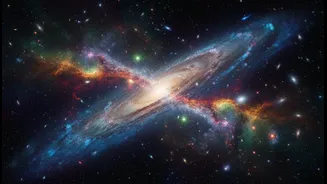
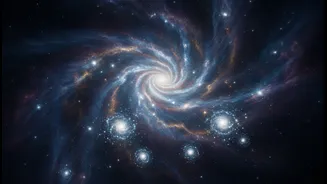
First, let's define a 'starburst'. Imagine a galaxy suddenly kicking its star production into hyperdrive. That's a starburst galaxy. While a typical galaxy like our Milky Way might form a few new stars per year, a starburst galaxy can churn out hundreds
in the same timeframe. It’s a frantic, galaxy-wide baby boom of stars. These events are spectacular but, logically, should be short-lived. A galaxy only has a finite reservoir of the gas and dust needed to form stars. At such a furious pace of creation, that fuel should be exhausted in a cosmologically brief period, perhaps a few hundred million years, which is a fraction of a galaxy's total lifespan. This creates a puzzle for astronomers: how can these intense bursts sometimes last longer than expected?
The Collision as a Trigger
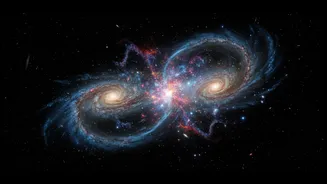
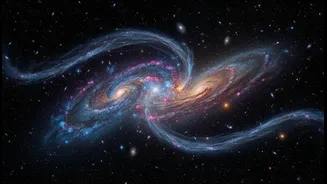
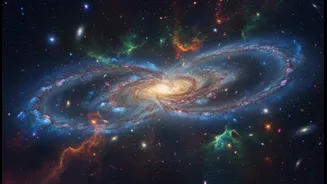
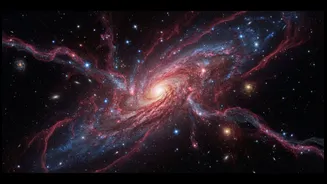
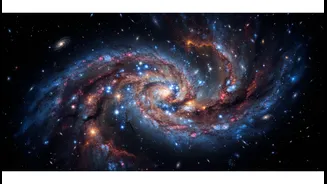
The vast majority of starburst galaxies observed in the local universe are found to be in the middle of a close encounter or an outright merger with another galaxy. When two galaxies collide, their stars rarely hit each other due to the immense distances between them. However, their vast clouds of gas and dust are not so lucky. The powerful gravitational forces of the interaction act like a giant cosmic hand, squeezing and compressing these clouds. This compression triggers a massive, cascading collapse of gas, igniting a firestorm of star formation across the galaxy. This is the primary mechanism that flips the switch on a starburst.
Sustaining the Fire
Triggering the burst is one thing, but keeping it going is another. This is where the longevity question comes in, and why collisions are so crucial to the answer. A simple fly-by might trigger a short burst, but a full-blown merger is a much more prolonged and complex process. As two galaxies spiral closer and eventually merge, the sustained gravitational chaos continuously funnels gas from the outer regions of both galaxies toward the new combined center. This process acts as a cosmic refueling line, steadily feeding the starburst and allowing it to rage for a much longer period than a single, isolated burst would allow. The collision doesn't just provide the initial spark; it provides the ongoing fuel supply that dictates the starburst's lifespan.
A Window to the Early Universe
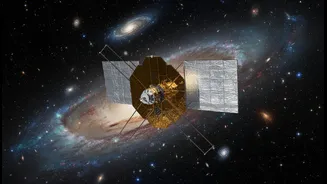
This connection becomes profoundly important when we look back in time to the early universe. In the first few billion years after the Big Bang, the universe was a much smaller and more crowded place. Galaxies were closer together, and as a result, collisions and mergers were far more common. Therefore, understanding how these merger-driven starbursts work is essential to understanding how the first massive galaxies grew and evolved. Recent observations from powerful tools like the James Webb Space Telescope (JWST) have confirmed this, showing that many ancient, massive galaxies that have since stopped forming stars show faint signs of a violent, merger-driven past. These early, intense starbursts, fueled by collisions, were a primary mode of galaxy construction in the young cosmos.