

A High-Altitude Chase for a Better View
One of the biggest challenges in studying a total solar eclipse is that they are frustratingly short, with totality lasting just a few minutes in any given location. To overcome this, a NASA team took to the skies in a WB-57 high-altitude research aircraft.
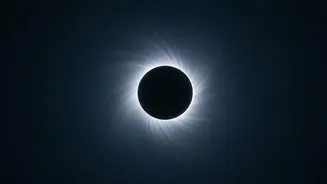
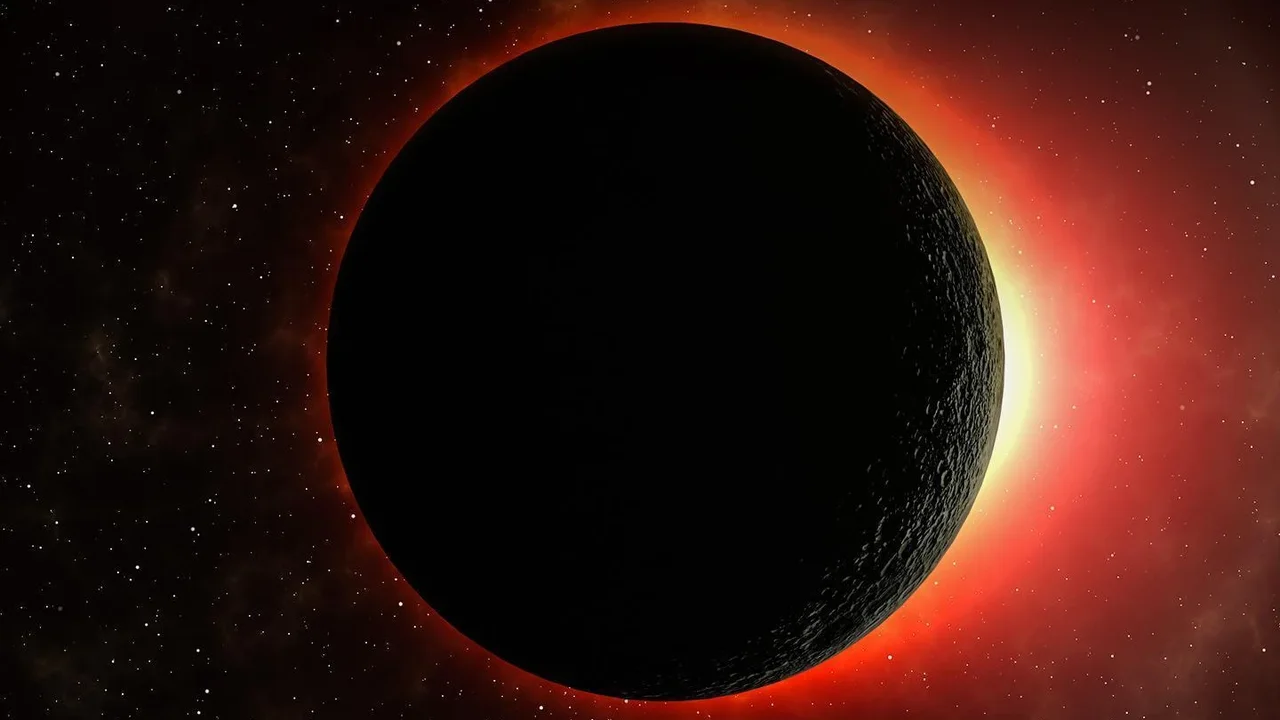
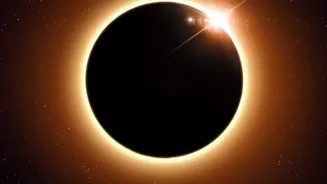
By flying at 50,000 feet along the eclipse path near Iceland, the jet not only soared above any disruptive clouds but also effectively 'chased' the Moon's shadow. This extended the observation time of the Sun's corona from just over two minutes to nearly three. Equipped with a suite of high-resolution cameras, the mission aimed to capture incredibly detailed images of the corona—the Sun's ethereal outer atmosphere that is millions of degrees hotter than its surface. Scientists are now poring over this data, hoping to better understand the mysterious heating mechanism of the corona and the origins of the solar wind, the stream of charged particles that constantly flows from the Sun and can impact satellites and technology on Earth.
Testing a Revolutionary New Instrument
Meanwhile, on the ground in Spain, another team was seizing the moment to test a potentially groundbreaking piece of technology. Scientists from Italy's National Institute for Astrophysics deployed a novel device called the Circular Slit Spectrometer (CISS). Traditionally, capturing the full spectrum of the corona—which reveals information about its temperature and composition—is a painstaking process that can take hours. The problem is that the corona itself can change in mere minutes. The new CISS instrument is designed to overcome this by capturing the spectrum of the entire corona in a single, instantaneous snapshot. The August 12 eclipse was its first major field test. If successful, this technology could revolutionize how we monitor the Sun's dynamic outer atmosphere, providing crucial data for improving space weather forecasts that protect our communication and power grids.
How Earth's Atmosphere Reacts
A solar eclipse doesn't just affect our view of the Sun; it also has a direct and immediate impact on Earth's own atmosphere. To study this, a NASA-supported project launched around 80 scientific balloons from Iceland before, during, and after totality. As the Moon’s shadow passes, it temporarily blocks incoming solar radiation, creating a unique, predictable, and localized atmospheric experiment. This causes noticeable drops in temperature and can even alter wind patterns. The balloons measured these changes in the 'boundary layer,' the part of the atmosphere closest to the ground. Understanding this rapid atmospheric response helps scientists refine weather models and gives them a clearer picture of how solar energy drives the climate and weather systems we experience every day. Observers on the ground confirmed the effect, noting how the air cooled as the world was plunged into a strange twilight.
First Glimpses and Future Discoveries
While the heavy data analysis is just getting underway, initial observations have already provided fascinating sights. This was the first total solar eclipse visible from mainland Spain in over a century, offering a spectacular show. Some observers in Spain reported seeing a rare, golden-hued corona instead of the usual pearly white. This was likely due to the Sun's low position on the horizon during the eclipse, combined with atmospheric smoke, which scattered blue light and allowed more golden tones to pass through. This observation is a perfect example of how Earth's atmosphere can influence our view of the cosmos. Teams from the European Space Agency also used the event to test their predictive models of the corona, comparing their forecasts to the real thing to improve future space weather predictions. For now, the images and data from aircraft, balloons, and ground observatories represent a treasure trove that will be studied for years to come, ensuring this eclipse's lessons will long outlast its fleeting moments of darkness.