








The Old Sky vs. The New
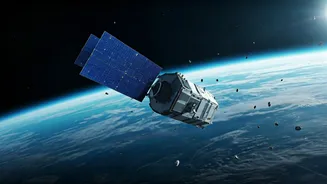
For decades, the word ‘satellite’ conjured images of massive, bus-sized machines, costing billions and taking years to build and launch. Typically, these were the exclusive domain of national space agencies like ISRO or NASA. They were powerful but few,
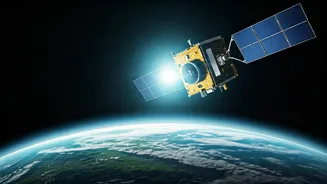
and the data they collected was often expensive and accessible only to a select group of scientists and government bodies. The new generation is the complete opposite. We are now in the era of ‘smallsats’ and ‘cubesats’—satellites that can be as small as a shoebox and built for a fraction of the cost. Companies can now launch entire constellations, sometimes numbering in the thousands, creating a persistent, high-frequency network in low Earth orbit. This shift from scarcity to abundance is the single biggest change, democratising access to space and unleashing a torrent of innovation.
Seeing the Unseen: Earth Observation 2.0
One of the most profound impacts is in Earth Observation (EO). Next-gen satellites are equipped with incredibly high-resolution cameras and advanced sensors like Synthetic Aperture Radar (SAR), which has the superpower of seeing through clouds and even at night. For India, the applications are game-changing. Farmers in Punjab can use satellite imagery to monitor crop health in real-time, apply fertilisers with precision, and get early warnings for pest attacks, boosting yields and saving costs. Urban planners in Mumbai or Bengaluru can track unauthorised construction, monitor traffic patterns, and manage urban sprawl more effectively. When disasters like the Kerala floods or cyclones in Odisha strike, these new satellites provide near-instantaneous maps of the affected areas, allowing rescue teams to identify stranded people and pinpoint the safest routes for aid. This isn't a forecast; it's a real-time, birds-eye view of our planet in action.
Connecting the Unconnected: Internet From Above
For millions in rural and remote India, reliable high-speed internet remains a distant dream. Laying fibre optic cables across difficult terrain is expensive and slow. This is where satellite internet constellations, spearheaded by companies like SpaceX’s Starlink and Bharti-backed OneWeb, come in. By blanketing the globe with thousands of small satellites in low orbit, they promise to deliver broadband-level speeds to the most inaccessible corners of the country. Imagine a student in a remote village in Arunachal Pradesh accessing online classes, a doctor in a rural clinic conducting a tele-consultation with a specialist in a metro city, or a local artisan selling their crafts directly to a global market. This technology has the potential to obliterate the digital divide, catalysing education, healthcare, and economic opportunity where it's needed most.
India’s New Space Race is Commercial
This revolution isn't just happening elsewhere; India is at its heart. Recognising the immense potential, the Indian government has opened up the space sector to private players. Through agencies like IN-SPACe (Indian National Space Promotion and Authorisation Centre), the government is actively encouraging startups to build and launch their own satellites. Indian companies like Pixxel are building constellations of hyperspectral satellites that can see the world in hundreds of colours, detecting information invisible to the human eye, such as soil composition or water pollution. Others, like Dhruva Space, are building the platforms and components that power these next-gen satellites. This has sparked a vibrant startup ecosystem, creating high-tech jobs and positioning India as a global hub for space technology and services. The new space race isn’t just between nations; it’s between innovative companies vying to build the future from orbit.