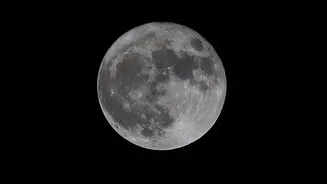







What Is the Hunter's Moon?
The Hunter's Moon is the name given to the full moon that immediately follows the Harvest Moon—the full moon occurring closest to the autumnal equinox. This year, the Hunter's Moon will reach its peak illumination on October 26, 2026. Its name dates back
to traditions where the bright moonlight of autumn was crucial for hunters stocking up on food for the winter. After farmers had cleared their fields during the Harvest Moon, the subsequent full moon would illuminate the stubble, making it easier for hunters to spot animals.
The Secret of the Shallow Angle
The key to the Hunter's Moon's special nature lies in its relationship with the ecliptic—the path the sun, moon, and planets appear to follow across our sky. During autumn in the Northern Hemisphere, the ecliptic makes a particularly shallow angle with the eastern horizon at sunset. While the moon typically rises about 50 minutes later each night, this shallow angle means that for several evenings around the full Hunter's Moon, the moonrise is delayed by only about 30 minutes. This results in a prolonged period of bright moonlight shortly after sunset, a phenomenon that was historically useful and today provides a stunning visual display.
An Urban Spectacle?
The headline's claim about 'exceptional viewing conditions across cities' is where things get interesting. It's not that cities offer a better environment—light pollution is always a challenge for stargazers. Instead, it’s that the unique characteristics of the Hunter's Moon are so powerful they can cut through the urban haze. The 'Moon Illusion' plays a huge role here. When the moon is low on the horizon, your brain compares its size to familiar objects like buildings, trees, and hills, making it appear dramatically larger than when it's high in the sky. This effect is an illusion, but a powerful one. Combined with its earlier rise time, city dwellers have a prime opportunity to see this seemingly giant moon framed by the urban landscape just after sunset.
Why It Appears Orange
The brilliant orange or reddish colour of the rising Hunter's Moon is not an illusion but a real physical effect. When the moon is near the horizon, its light must travel through a much thicker slice of Earth's atmosphere to reach your eyes. This dense layer of air scatters shorter-wavelength blue and green light, allowing the longer-wavelength red, orange, and yellow light to pass through more easily. The result is that any full moon viewed near the horizon will have a warm, pumpkin-like hue, but it’s especially noticeable with the Hunter's Moon because of its low-hanging, dramatic entrance into the evening sky.
How to Get the Best View
You don't need any special equipment to enjoy the Hunter's Moon. The most important factor is finding a location with an unobstructed view of the eastern horizon. For the most dramatic effect, plan to head out on the evening of Sunday, October 25, 2026, just before your local sunset time. This will allow you to watch the moon emerge from the horizon while the sky is still painted with twilight colours, providing the best opportunity to experience the Moon Illusion and its fiery orange glow. Rooftops, parks, or any elevated spot can offer a great vantage point, even within a city.