



A Telescope That Peers Through Time
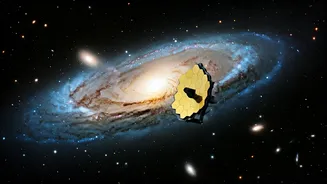
The James Webb Space Telescope is not just another telescope; it's a time machine. Its powerful infrared instruments were specifically designed to capture light that has traveled for over 13 billion years, giving us a glimpse of the 'cosmic dawn'—the
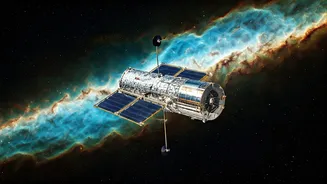
era when the very first stars and galaxies began to shine. Because the universe is expanding, light from these distant objects gets stretched into longer, redder wavelengths, a phenomenon known as redshift. The JWST's unparalleled sensitivity to this infrared light allows it to see farther back in time than any previous observatory, like the Hubble Space Telescope, whose view was often obscured by cosmic dust. It was built to answer fundamental questions about how the universe began, but its initial findings are creating brand-new questions altogether.
The Unexpectedly Grown-Up Galaxies
The leading cosmological model, known as Lambda-CDM, predicted that the first galaxies would be small, clumpy, and chaotic. However, the JWST is consistently finding something else entirely. In the first few hundred million years after the Big Bang, a time when galaxies should have been just starting to form, Webb is spotting objects that are astonishingly massive, structured, and bright. Some of these galaxies, seen as they were just 500-700 million years post-Big Bang, appear to contain billions of stars, rivaling the size of our own Milky Way which had billions of more years to grow. Others show surprising chemical maturity, with heavier elements that astronomers didn't expect to see so early. This has led some to dub them 'universe breakers' because their existence simply doesn't fit with our established timeline of cosmic evolution.
Rewriting the Cosmic Story
These discoveries are forcing a major rethink of galaxy formation. If these massive galaxies exist, it implies one of several startling possibilities. First, star formation in the early universe may have been incredibly efficient, converting nearly 100% of available gas into stars at a furious pace—far beyond the 10% rate we see today. Second, the standard model of cosmology itself might need adjustments. Perhaps the universe expanded faster after the Big Bang than we thought, or maybe there was more matter available for galaxy-building than current theories account for. Another theory gaining traction is that some of these bright objects aren't just galaxies, but are powered by ravenous supermassive black holes at their centers, which makes them appear brighter and more massive than they are. Recent JWST observations of a protocluster—a group of at least six galaxies merging—suggests this rapid assembly could be one way these cosmic giants form.
More Than Just Pretty Pictures
While the images are stunning, their scientific value is what truly matters. Each new observation is another piece of a puzzle that is becoming more complex and fascinating. Astronomers are now using the JWST's spectroscopic tools to dissect the light from these objects, confirming their immense distances and analyzing their chemical makeup. This detailed analysis helps differentiate between a massive galaxy full of stars and a very active black hole, or even stranger phenomena like the mysterious 'little red dots' that are now being investigated. What is clear is that our understanding of the early universe was incomplete. The neat, gradual story of galaxy formation is being replaced by a more dramatic and accelerated narrative. These ancient galaxies, once thought of as faint and primitive, are now at the center of a scientific revolution, feeling entirely newly discovered.