

What Exactly is the 'Little Red Dot'?
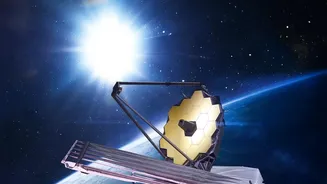
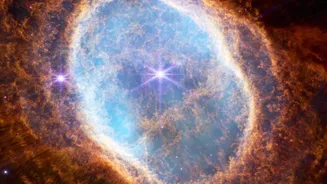
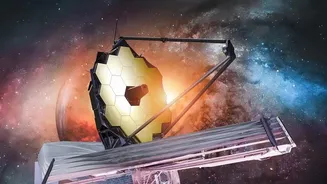
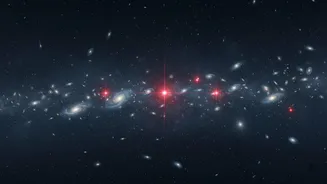
In the vast, dark canvas of space, the James Webb Space Telescope has been spotting what astronomers affectionately call 'little red dots'. These are not stars, but entire galaxies from the universe's infancy. One of the most famous of these is JADES-GS-z14-0,
a galaxy whose light has travelled for over 13.5 billion years to reach us. We are seeing it as it was just 290 million years after the Big Bang, when the universe was only 2% of its current age. The reason it appears as a tiny red point is twofold. Firstly, it is incredibly far away. Secondly, its light has been stretched by the expansion of the universe over its long journey, a phenomenon known as redshift, shifting it to the redder end of the light spectrum.
Why Extreme Distance is the Real Story
The headline's call to focus on 'extreme distance' hits the nail on the head. For cosmologists, distance is time. Measuring a galaxy's redshift allows them to calculate its distance and, therefore, how far back in cosmic history they are looking. JADES-GS-z14-0 has a confirmed redshift of 14.32, shattering previous records. This extreme distance is what makes it so revolutionary. Finding a galaxy so far back in time is like discovering a fully-formed city where you only expected to find a small village. The existence of such a bright and large galaxy so early on poses a fundamental challenge to existing theories of galaxy formation, which predicted a slower, more gradual process.
A Universe That Grew Up Too Fast
The discovery of JADES-GS-z14-0 and other similar objects suggests the early universe was far more developed than models had anticipated. This galaxy is surprisingly massive for its age, estimated to contain several hundred million times the mass of our Sun in stars. The light is coming from young stars, not a central supermassive black hole, meaning the galaxy itself is intrinsically luminous. This implies that nature found a way to create large, structured galaxies in less than 300 million years. Furthermore, analysis of the galaxy's light has revealed the presence of oxygen, an element forged inside stars and dispersed when they die. Finding oxygen so early suggests that multiple generations of stars had already lived and died, a process that scientists thought would take much longer.
Not Just a Point, But a Puzzle
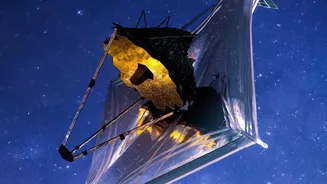
The research is now moving far beyond simply cataloging these red dots. Using advanced instruments like Webb's Near-Infrared Spectrograph (NIRSpec), scientists are dissecting the light to understand the physical properties of these ancient systems. Spectroscopy reveals the chemical composition, temperature, and density of the gas within the galaxy. This detailed analysis is what confirmed the presence of oxygen and provides clues about the rate of star formation. By studying the spectrum, astronomers can distinguish the light of stars from the glow of gas being consumed by a black hole. This deep dive into the data is what transforms a simple point of light into a detailed case study of cosmic dawn, allowing scientists to test and refine their models of how the universe evolved.
The Next Frontier of Cosmic Dawn
The discovery of JADES-GS-z14-0 is not an endpoint but a starting line. Its existence in a relatively small patch of the observed sky implies that there could be many more of these bright, early galaxies waiting to be found. Astronomers are now pushing Webb to its limits, searching for even earlier objects that might take us back to within the first 200 million years after the Big Bang. Each new discovery provides a crucial data point for understanding the era of 'reionization', a key period when the light from the first stars and galaxies burned through the neutral hydrogen fog that once filled the universe. These little red dots are the lighthouses guiding our exploration of that foggy, primordial cosmic sea.