






If you feel stiff and achy after a long day at your desk, you're not alone. Prolonged sitting takes a toll on your joints, but the solution doesn't require a gym. Simple, consistent movement breaks can make a world of difference.
How Sitting Stiffens Your Joints
Our bodies are designed
for movement. When you sit for hours on end, your body adapts to that fixed position, leading to predictable patterns of tightness and discomfort. Your hip flexors, the muscles at the front of your hips, remain in a shortened position, while your glute muscles become less active. This combination can lead to a feeling of stiffness in the hips and contribute to lower back pain. Meanwhile, a forward-hunching posture over a keyboard causes chest muscles to tighten and the muscles of your upper back to become overstretched and weak. Over time, this lack of movement reduces the circulation of synovial fluid, a natural lubricant in your joints, making them feel stiff and restricted. This doesn't mean sitting is inherently bad, but staying in any one position for too long can cause issues.
The Power of Micro-Movements
The antidote to prolonged stillness isn't necessarily an intense workout. Research shows that short, frequent movement breaks—sometimes called 'movement snacks'—are incredibly effective. Taking a break to stand, stretch, or walk for just a few minutes every hour can improve circulation, reduce muscle tension, and combat joint stiffness. The key is consistency. These small interruptions break the cycle of sedentary posture and remind your muscles and joints to move through their full range. Studies indicate these breaks can also boost mood, improve focus, and reduce fatigue without harming productivity.
For Your Hips and Lower Back
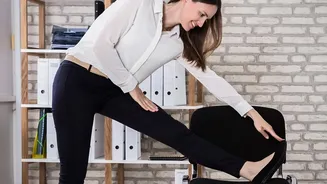
These movements target the areas most affected by long hours in a chair. Aim to perform them gently, without forcing any position. Seated Figure-Four Stretch: While sitting tall, cross your right ankle over your left knee. Keeping your back straight, gently lean forward until you feel a stretch in your right glute and hip. Hold for 20-30 seconds and repeat on the other side. This targets the deep hip rotator muscles. Seated Spinal Rotation: Sit upright with your feet flat on the floor and cross your arms over your chest. Slowly twist your upper body to the right, keeping your hips still. Hold briefly, then return to the center and rotate to the left. This helps mobilize the thoracic spine. Standing Hip Flexor Stretch: Stand up and take a small step back with your right leg. Keeping your torso upright, gently squeeze your right glute and press your hips forward until you feel a stretch at the front of your right hip. Hold for 20-30 seconds before switching sides.
For Your Shoulders and Chest
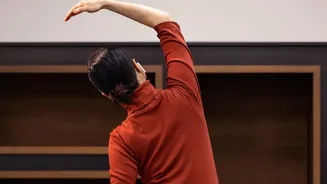
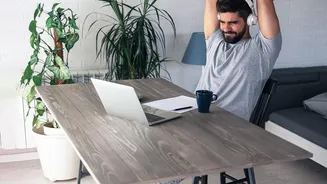
Counteract the effects of hunching forward with these simple, opening stretches. Shoulder Blade Squeezes: Sit or stand tall with your arms relaxed at your sides. Gently squeeze your shoulder blades together as if you're trying to hold a pencil between them. Hold the squeeze for 3–5 seconds, then relax. This activates the underused muscles of your upper back. Chest Stretch at a Wall or Doorway: Stand in a doorway or next to a wall. Place your right forearm on the frame or wall with your elbow at about shoulder height. Gently rotate your chest away from the wall until you feel a stretch across your chest and the front of your shoulder. Hold for 20–30 seconds, and repeat on the left side. Overhead Reach: While seated or standing, interlace your fingers and push your palms toward the ceiling, straightening your arms. Reach up and slightly back to feel a stretch through your shoulders and upper back. Hold for 15 seconds, remembering to breathe deeply.
For Your Neck and Spine
Release tension that builds up from looking at a screen. Chin Tucks: Sit or stand tall, looking straight ahead. Gently glide your head straight back, creating a 'double chin' without tilting your head up or down. You should feel a gentle activation in the front of your neck and a stretch at the back. Hold for a few seconds and repeat 5–10 times to counteract 'tech neck'. Gentle Neck Rotations: Slowly turn your head to look over your right shoulder, holding for a few seconds. Return to the center, then turn to look over your left shoulder. Avoid pushing into any pain and keep the movement smooth and controlled.
How to Make It a Habit
Knowing the exercises is one thing; remembering to do them is another. The most effective strategy is to link movement to your existing routine. Stand up every time you take a phone call. Perform a few shoulder rolls after you send a long email. Set a simple timer on your phone or computer to remind you to get up and move for a couple of minutes every hour. The goal isn't to disrupt your workflow but to weave these small moments of self care into your day even just choosing to stand and walk around for a minute can have a cumulative positive effect on how you feel.