




The Sleeping Giants of the Universe
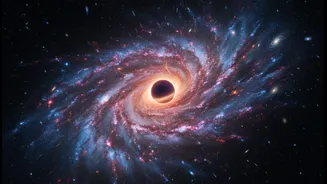
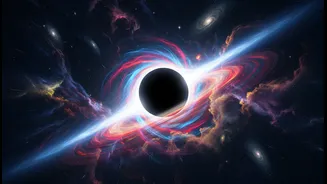
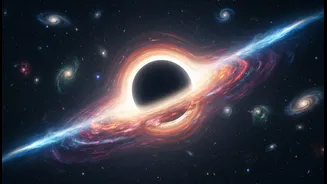
At the heart of most large galaxies, including our own Milky Way, lies a supermassive black hole (SMBH). These behemoths have masses millions or even billions of times greater than our Sun. For most of their existence, these cosmic monsters are dormant,
or 'sleeping'.. They are not actively devouring large amounts of material, which makes them incredibly difficult to see directly. Their presence is usually inferred by the orbits of stars around the galactic center. Think of them as quiet engines at the core of a galaxy, waiting for fuel.
What is an Active Galactic Nucleus?
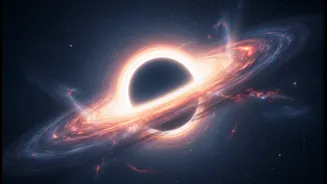
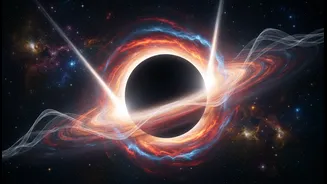
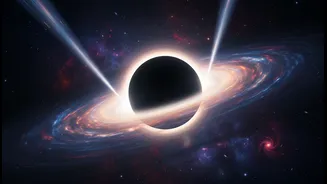
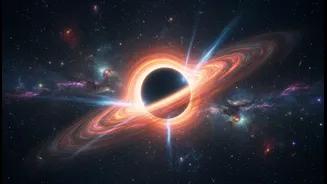
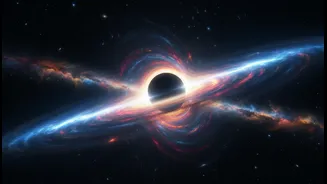
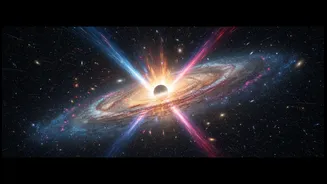
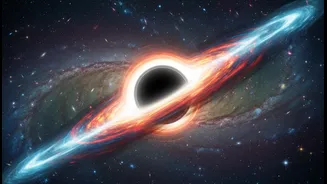
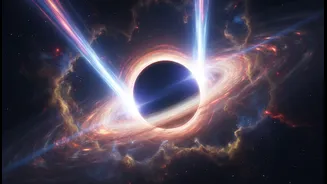
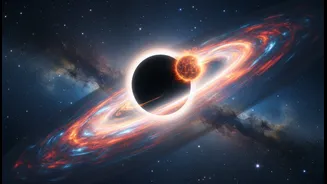
When a supermassive black hole starts actively feeding on the surrounding gas and dust, the galactic center transforms into an incredibly bright and energetic region known as an Active Galactic Nucleus, or AGN.. As material spirals into the black hole, it forms a structure called an accretion disk.. Friction within this disk heats the material to extreme temperatures, causing it to glow intensely across the entire electromagnetic spectrum, from radio waves to X-rays.. This intense radiation makes an AGN one of the most luminous objects in the universe, sometimes outshining all the stars in its host galaxy combined. The sudden appearance of an AGN signifies a dramatic shift from a quiet, inactive state to a dynamic, feeding frenzy.
A Real-Time Awakening
Recently, astronomers observed a galaxy named SDSS1335+0728, located about 300 million light-years away, do something unprecedented. After decades of being unremarkable and quiet, its core began to brighten dramatically in late 2019.. The brightness has continued to increase over the past four years, radiating much more light in ultraviolet, optical, and infrared wavelengths, and even starting to emit X-rays in February 2024.. This is significant because other cosmic events that cause sudden brightening, like a supernova or a star being torn apart (a tidal disruption event), typically last for only a few hundred days at most.. The sustained and increasing luminosity of SDSS1335+0728 has led astronomers to conclude they are witnessing the activation of a black hole in real time for the first time ever..
From Quiescent to 'Changing-Look'
This phenomenon is part of a broader class of objects called 'Changing-Look' AGNs. These are galaxies whose central engines show dramatic transformations on human timescales, appearing or disappearing over months or years.. The changes are so significant that the galaxy's classification can shift, for example, from appearing to have no active black hole to suddenly showing all the signs of one. Scientists believe these changes are driven by rapid fluctuations in the rate at which the black hole is accreting material.. The case of SDSS1335+0728 is a prime example of a galaxy transitioning into a 'changing-look' state, offering a unique chance to study the process as it happens, rather than just seeing the 'before' and 'after' pictures from archival data.
Why This Discovery Matters
Observing a black hole 'turn on' provides invaluable information on how these giants grow and evolve, and how they influence their host galaxies.. AGNs can release enormous amounts of energy that can heat up or blow away gas, potentially shutting down star formation within the galaxy. Understanding the 'duty cycle' of a black hole—how often it switches between active and dormant states—is crucial for refining our models of galaxy formation and evolution.. The ongoing observations of SDSS1335+0728 will allow scientists to test theories about accretion disk physics and the formation of the structures around AGNs. While astronomers believe our own galaxy's black hole, Sagittarius A*, could potentially do the same, it is unclear how likely this is..