




The Sun’s Turbulent Threat
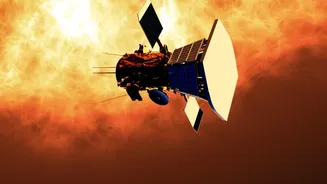
The Sun isn't always the steady, benign star it appears to be. It has a cycle of activity, and during its peaks, it can unleash powerful solar flares and coronal mass ejections (CMEs). These events hurl vast clouds of charged particles and magnetic fields
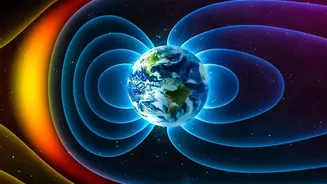
into space. When a CME is aimed at Earth, it can take one to three days to arrive, but its impact can be significant. While we are protected on the ground by our planet's magnetic field, this interaction creates what is known as a geomagnetic storm. These storms can heat up the upper atmosphere, causing it to expand and increase the drag on satellites in low-Earth orbit. They can also supercharge the ionosphere, a layer of Earth's atmosphere filled with charged particles, creating a chaotic environment for the radio signals that pass through it.
A Scintillating Problem for Satellites
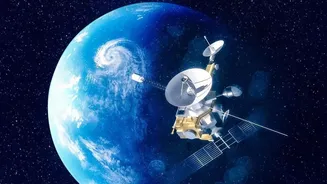
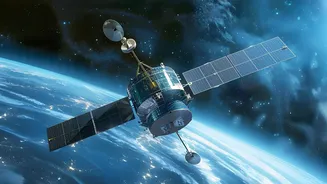
The primary problem for satellite communication during a solar storm is a phenomenon called ionospheric scintillation. Think of it like the twinkling of a star, but for radio signals. As GPS and communication signals travel from a satellite down to a receiver on Earth, they must pass through the ionosphere. During a geomagnetic storm, irregularities and plasma bubbles form in this layer, scattering the radio signals. This causes rapid fluctuations in the signal's amplitude and phase, which your GPS receiver or DTH box interprets as noise or, in severe cases, a complete loss of signal. This can lead to inaccurate GPS positioning, dropped satellite phone calls, and frozen TV screens—disruptions that affect logistics, transportation, finance, and entertainment. The effect is particularly strong in equatorial regions, which includes all of southern India.
A Breakthrough in Prediction
Until recently, predicting exactly where and when these signal-disrupting plasma bubbles would form has been extremely difficult. However, new research is changing the game. Scientists are now leveraging machine learning and vast amounts of data from satellite constellations to create predictive models. One recent study highlighted how analysing data from multiple satellites can reveal the physical triggers and cascading effects of these disruptions, allowing for more localised forecasts. Instead of just knowing a storm is coming, these models can predict which specific orbits and geographic regions are most likely to experience severe scintillation, sometimes hours in advance. This is akin to moving from a general cyclone alert to a detailed forecast showing which specific coastlines will be hit the hardest and when.
From Prediction to Protection
This newfound predictive power unlocks proactive mitigation strategies. Knowing which parts of a satellite network will be vulnerable allows operators to take evasive action. For instance, network traffic could be rerouted through satellites in less affected orbits, ensuring a stable connection. In some cases, satellite operators could preemptively switch to different, more robust frequencies that are less susceptible to scintillation. Another proposed, more futuristic concept involves launching dedicated spacecraft that could release chemicals like barium to create a temporary plasma 'airbag' or 'Storm Wall', effectively fortifying a section of the magnetosphere to deflect the storm's energy. While a long way from implementation, it shows the creative thinking spurred by better forecasting.
Why This Matters for a Digital India
For an increasingly connected nation like India, satellite resilience is critical. The country's dependence on the Indian Regional Navigation Satellite System (NavIC) for strategic and civilian purposes, from disaster management to vehicle tracking, makes it vulnerable. The logistics and ride-hailing industries rely on precise GPS for efficiency. Furthermore, India has one of the world's largest Direct-to-Home (DTH) markets, with millions of households relying on uninterrupted satellite signals for news and entertainment. Even financial transactions can be affected, as some systems use satellite signals for precise time-stamping. Ensuring these services remain stable during solar storms is crucial for economic continuity and national security. This research provides a pathway to building a more robust digital infrastructure that is less susceptible to the whims of space weather.