

The Moon's Coldest Secrets
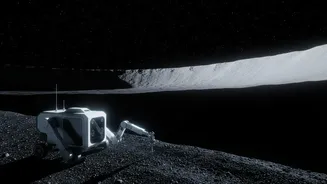
Imagine a place untouched by sunlight for billions of years. These are the Permanently Shadowed Regions, or PSRs, located in deep craters near the lunar poles. Because the Moon's axial tilt is very small, the sun never rises above the crater rims, leaving
their floors in a state of perpetual deep freeze. Temperatures in these areas can plummet to as low as minus 250 degrees Celsius, making them some of the coldest spots in our solar system. These extreme conditions create perfect 'cold traps', preserving volatile compounds like water, which arrive via comets and asteroids or from ancient lunar volcanic activity. Recent studies and data from missions like Chandrayaan-2 suggest that these craters could hold substantial deposits of water-ice, especially a few meters below the surface.
Why Water is the New Lunar Gold
Finding water on the Moon is not just about quenching the thirst of future astronauts. Water-ice is considered a game-changing resource for in-situ resource utilization (ISRU), which is the principle of living off the land. Firstly, it can be purified for drinking and used to grow food in a potential lunar habitat. Secondly, its constituent elements, hydrogen and oxygen, can be separated. The oxygen can be used to create breathable air for astronauts. More importantly, liquid hydrogen and liquid oxygen are the primary components of powerful rocket propellant. The ability to refuel spacecraft on the Moon would dramatically reduce the cost and complexity of deep-space missions, making the Moon a stepping stone for journeys to Mars and beyond.
ISRO's Blueprint for a New Frontier
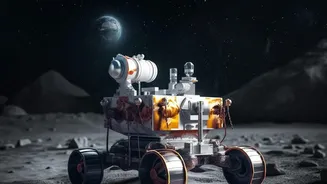
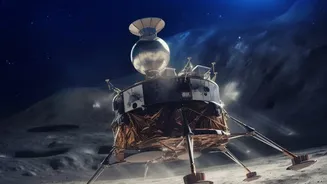
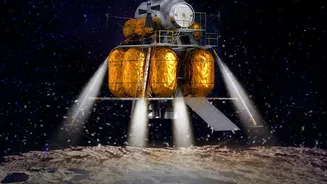
ISRO is actively planning its next steps to harness these resources, building on the success of its Chandrayaan missions. A key project on the horizon is the Lunar Polar Exploration Mission (LUPEX), a joint endeavor with the Japan Aerospace Exploration Agency (JAXA). Scheduled to launch no earlier than 2028, LUPEX is designed to land near the lunar south pole and deploy a sophisticated rover. Under the partnership, ISRO will provide the lander, while JAXA is developing the rover, which will also carry instruments from NASA and the European Space Agency. The mission's primary goal is to directly investigate the quantity and quality of water-ice in a permanently shadowed region, drilling up to 1.5 meters below the surface to collect samples for analysis.
The Challenge of Mining in Darkness
Extracting resources from a PSR is an immense engineering challenge. The mission must operate in complete darkness and withstand extreme cold that can make materials brittle and electronics fail. Since solar power is not an option inside the craters, any rover or lander will require an alternative energy source, such as advanced batteries or radioisotope power systems. The LUPEX rover, for instance, will need robust systems to survive a mission expected to last for more than 100 days. The technology for extraction will likely involve drills to access the subsurface ice and heating elements to sublimate it—turning the solid ice directly into water vapor, which can then be captured and stored. Overcoming these hurdles is crucial for turning the theoretical potential of lunar water into a practical reality.
India's Stake in the Global Lunar Race
ISRO's focus on lunar water extraction places India at the forefront of a new global space race. It's a strategic shift from pure exploration to resource utilization, a domain that nations like the US and China are also keenly pursuing. Successfully demonstrating the ability to extract lunar water would not only be a monumental scientific achievement but also a significant geopolitical statement. It would bolster India's position as a major spacefaring nation and ensure its role in shaping the future of lunar development and commerce. This ambitious plan is a cornerstone of India's long-term vision for space, which includes landing an Indian astronaut on the Moon by 2040. By targeting these shadowed craters, ISRO is not just exploring the Moon; it's unlocking a sustainable future in space.